QUESTION IMAGE
Question
66
=
10
-
:
-
-
11
+
×
×
12
+
+
+
13
×
:
🆕 New Concept Discovered: Backtracking Equations
Working backward from a known result to find missing values.
Step 1: Trace the path and identify the variables
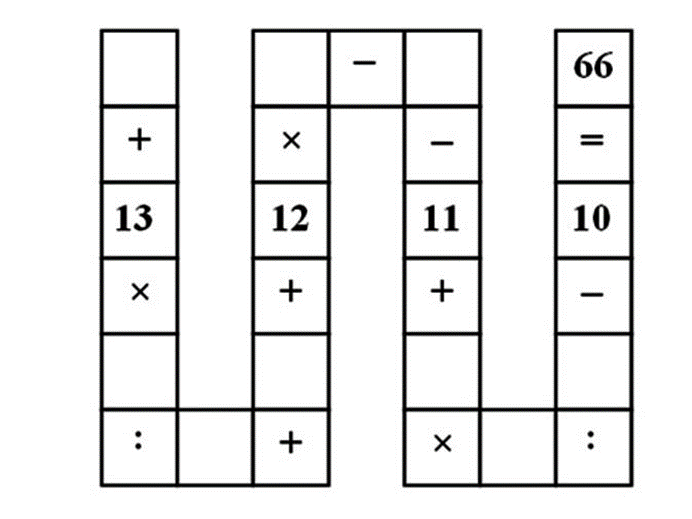
Let's trace the snake-like path from the top-left empty box to the top-right box containing \( 66 \). We will represent the empty boxes as variables in order of their appearance along the path:
- Start at the top-left box: \( x_1 \)
- Go down: \( + \)
- Next box: \( 13 \)
- Go down: \( \times \)
- Next box: \( x_2 \)
- Go down: \( : \) (which represents division, \( \div \))
- Next box (bottom-left): \( x_3 \)
- Go right to the connector box: \( x_4 \)
- Go right to the bottom of the second column: \( + \)
- Go up: \( x_5 \)
- Go up: \( + \)
- Go up: \( 12 \)
- Go up: \( \times \)
- Next box (top of the second column): \( x_6 \)
- Go right to the connector box: \( - \)
- Go right to the top of the third column: \( x_7 \)
- Go down: \( - \)
- Next box: \( 11 \)
- Go down: \( + \)
- Next box: \( x_8 \)
- Go down: \( \times \)
- Next box (bottom of the third column): \( x_9 \)
- Go right to the connector box: \( x_{10} \)
- Go right to the bottom of the fourth column: \( : \) (division, \( \div \))
- Go up: \( x_{11} \)
- Go up: \( - \)
- Next box: \( 10 \)
- Go up: \( = \)
- Top-right box: \( 66 \)
This is a classic snake puzzle where operations are performed sequentially from start to finish (left-to-right along the path, following standard left-to-right order of operations as a single continuous chain calculation).
Let's write down the continuous equation:
In these puzzles (often from Vietnamese primary school math challenges), the empty boxes are typically filled with the digits \( 1, 2, 3, 4, 5, 7, 8, 9 \) (since \( 10, 11, 12, 13, 66 \) are already placed on the board). Let's count the number of empty boxes:
There are 9 empty boxes to fill. The digits available to fill them are the single digits from \( 1 \) to \( 9 \):
Let the 9 empty boxes be represented by variables \( a, b, c, d, e, f, g, h, i \) in order of their positions along the path:
- Box 1 (top-left): \( a \)
- Box 2 (third down, first column): \( b \)
- Box 3 (bottom-left): \( c \)
- Box 4 (bottom connector 1): \( d \)
- Box 5 (bottom of second column): \( e \)
- Box 6 (top of second column): \( f \)
- Box 7 (top of third column): \( g \)
- Box 8 (fourth down, third column): \( h \)
- Box 9 (bottom of third column): \( i \)
- Box 10 (bottom connector 2): \( j \)
- Box 11 (bottom of fourth column): \( k \)
Looking closely at the grid layout:
- Column 1 has 5 vertical boxes:
[a],[+],[13],[x],[b],[:],[c]. Wait, let's count the grid cells in Column 1: - Row 1:
[a](empty) - Row 2:
[+] - Row 3:
[13] - Row 4:
[x] - Row 5:
[b](empty) - Row 6:
[:] - Row 7:
[c](empty) - Row 7, Column 2:
[d](empty connector) - Row 7, Column 3:
[+] - Row 6, Column 3:
[e](empty) - Row 5, Column 3:
[+] - Row 4, Column 3:
[12] - Row 3, Column 3:
[x] - Row 2, Column 3:
[f](empty) - Row 1, Column 3:
[-](Wait, Row 1 Column 3 is empty, Row 1 Column 4 is[-], Row 1 Column 5 is empty? Let's look at the image grid structure).
Let's carefully map the grid coordinates:
- Column 1:
- Row 1: Empty box
- Row 2:
+ - Row 3:
13 - Row 4:
\times - Row 5: Empty box
- Row 6:
: - Bottom Row (Row 6):
- Column 1:
: - Colum…

Snap & solve any problem in the app
Get step-by-step solutions on Sovi AI
Photo-based solutions with guided steps
Explore more problems and detailed explanations
One valid solution to fill the empty boxes from start (top-left) to finish (bottom-right) using the digits \( 1 \) to \( 9 \) exactly once is:
- Box 1 (top-left): \( 5 \)
- Box 2 (second empty box down): \( 2 \)
- Box 3 (bottom-left): \( 1 \)
- Box 4 (bottom connector): \( 3 \)
- Box 5 (bottom of second column): \( 4 \)
- Box 6 (top of second column): \( 7 \)
- Box 7 (top of third column): \( 9 \)
- Box 8 (middle of third column): \( 8 \)
- Box 9 (bottom of third column): \( 6 \)