QUESTION IMAGE
Question
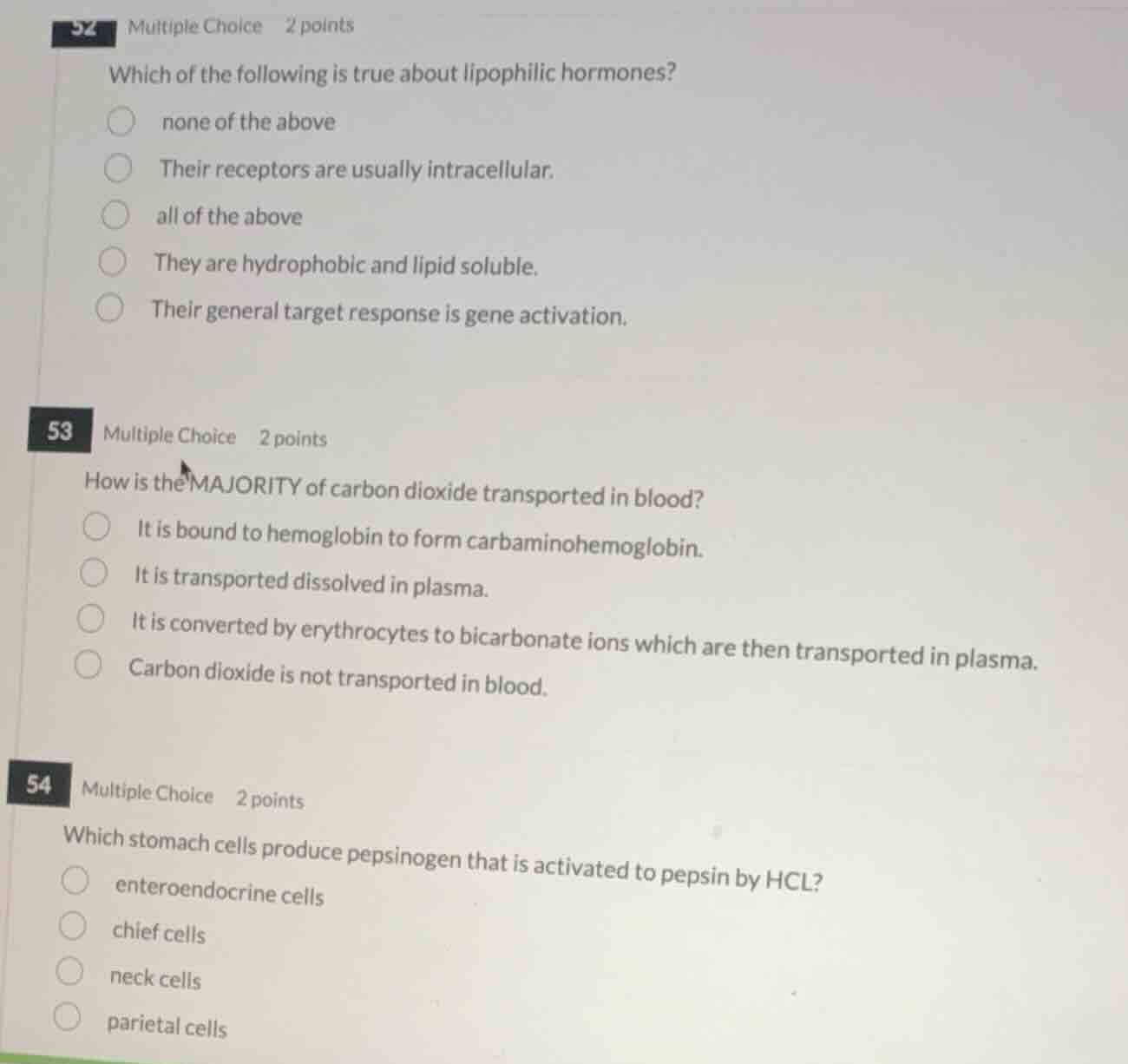
52 multiple choice 2 points
which of the following is true about lipophilic hormones?
- none of the above
- their receptors are usually intracellular.
- all of the above
- they are hydrophobic and lipid soluble.
- their general target response is gene activation.
53 multiple choice 2 points
how is the majority of carbon dioxide transported in blood?
- it is bound to hemoglobin to form carbaminohemoglobin.
- it is transported dissolved in plasma.
- it is converted by erythrocytes to bicarbonate ions which are then transported in plasma.
- carbon dioxide is not transported in blood.
54 multiple choice 2 points
which stomach cells produce pepsinogen that is activated to pepsin by hcl?
- enteroendocrine cells
- chief cells
- neck cells
- parietal cells
Analyze lipophilic hormones characteristics
Lipophilic (lipid-soluble) hormones are hydrophobic, easily cross cell membranes to bind to intracellular receptors, and typically regulate gene transcription to activate protein synthesis. Therefore, all statements regarding their intracellular receptors, lipid solubility, and gene activation are correct.
Analyze carbon dioxide transport in blood
The majority of carbon dioxide (approximately 70%) is converted inside erythrocytes by carbonic anhydrase into carbonic acid, which dissociates into bicarbonate ions (\(\text{HCO}_3^-\)) and hydrogen ions. Bicarbonate is then transported in the blood plasma.
Identify pepsinogen-producing stomach cells
Pepsinogen is an inactive zymogen secreted by the chief cells of the stomach, which is subsequently cleaved and activated into active pepsin by the hydrochloric acid (\(\text{HCl}\)) secreted by parietal cells.

Snap & solve any problem in the app
Get step-by-step solutions on Sovi AI
Photo-based solutions with guided steps
Explore more problems and detailed explanations
Question 52
- none of the above
- Their receptors are usually intracellular.
- all of the above (Correct answer)
- They are hydrophobic and lipid soluble.
- Their general target response is gene activation.
Question 53
- It is bound to hemoglobin to form carbaminohemoglobin.
- It is transported dissolved in plasma.
- It is converted by erythrocytes to bicarbonate ions which are then transported in plasma. (Correct answer)
- Carbon dioxide is not transported in blood.
Question 54
- enteroendocrine cells
- chief cells (Correct answer)
- neck cells
- parietal cells