QUESTION IMAGE
Question
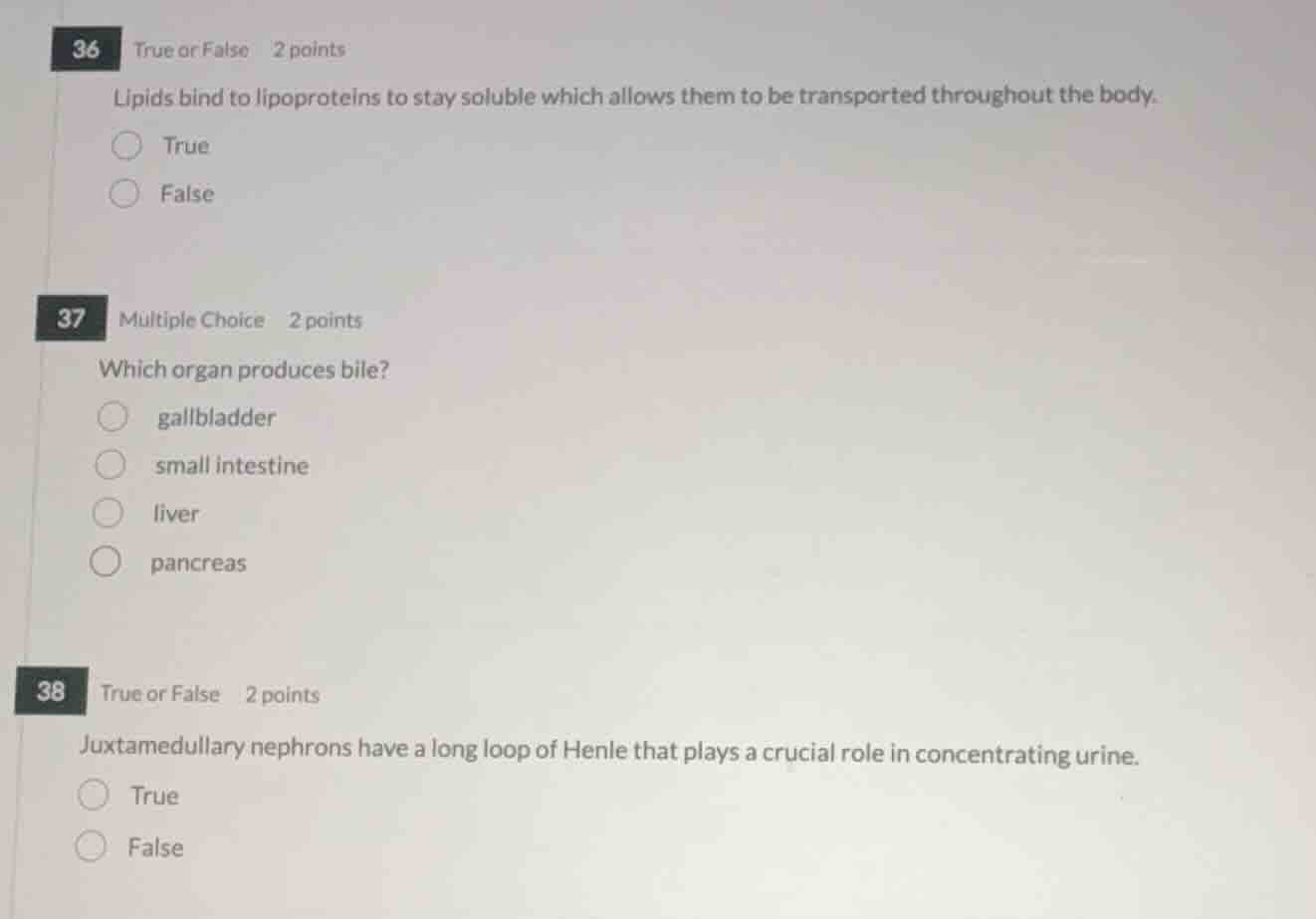
36 true or false 2 points
lipids bind to lipoproteins to stay soluble which allows them to be transported throughout the body.
true
false
37 multiple choice 2 points
which organ produces bile?
gallbladder
small intestine
liver
pancreas
38 true or false 2 points
juxtamedullary nephrons have a long loop of henle that plays a crucial role in concentrating urine.
true
false
Analyze Question 36
Lipids are hydrophobic and insoluble in water. To be transported in the aqueous environment of the bloodstream, they bind to proteins to form water-soluble lipoproteins. Thus, the statement is true.
Analyze Question 37
Bile is synthesized and produced by hepatocytes in the liver. It is then stored and concentrated in the gallbladder before being released into the small intestine. Therefore, the liver is the organ that produces bile.
Analyze Question 38
Juxtamedullary nephrons are characterized by having long loops of Henle that extend deep into the renal medulla. This structural feature is essential for establishing the medullary osmotic gradient required to concentrate urine. Thus, the statement is true.

Snap & solve any problem in the app
Get step-by-step solutions on Sovi AI
Photo-based solutions with guided steps
Explore more problems and detailed explanations
Question 36
- True (Correct answer)
- False
Question 37
- gallbladder
- small intestine
- liver (Correct answer)
- pancreas
Question 38
- True (Correct answer)
- False