QUESTION IMAGE
Question
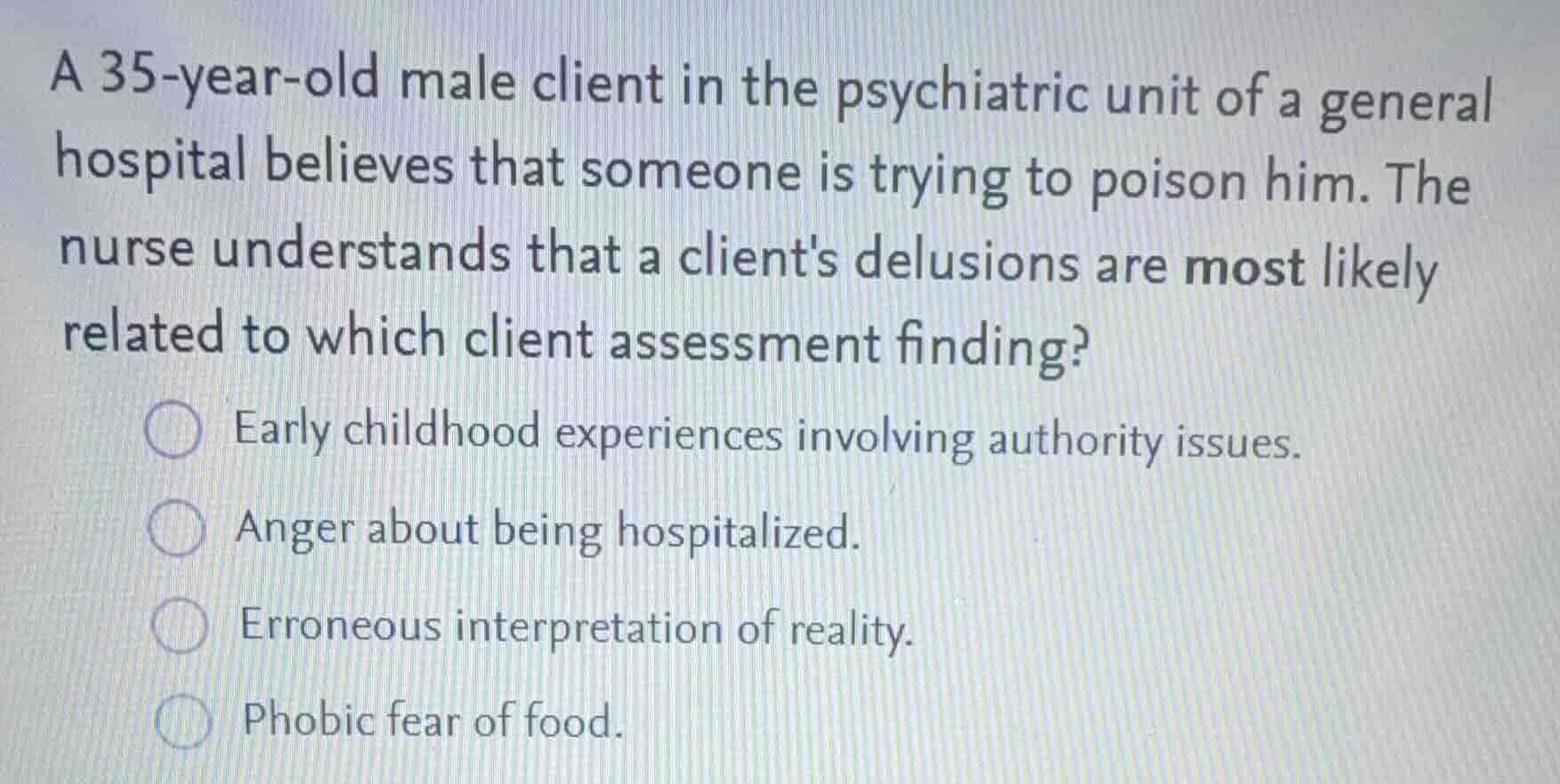
a 35-year-old male client in the psychiatric unit of a general hospital believes that someone is trying to poison him. the nurse understands that a clients delusions are most likely related to which client assessment finding?
early childhood experiences involving authority issues.
anger about being hospitalized.
erroneous interpretation of reality.
phobic fear of food.
Define the nature of a delusion
A delusion is clinically defined as a fixed, false belief that is resistant to reason or contrary to actual facts. It represents a fundamental error in how an individual perceives, processes, and interprets external reality.
Evaluate the clinical options
- Early childhood experiences involving authority issues: This is a psychodynamic theory of origin rather than an active clinical assessment finding that defines the delusion itself.
- Anger about being hospitalized: While anger may coexist with hospitalization, it is an emotional state rather than the cognitive mechanism underlying a delusion.
- Erroneous interpretation of reality: This directly aligns with the clinical definition of a delusion, where the client misinterprets environmental cues or events as threatening (e.g., believing food/medication is poison).
- Phobic fear of food: A phobia is an irrational fear where the individual typically maintains reality testing, whereas a persecutory delusion involves a false belief system about intent (poisoning).
Select the most accurate assessment finding
The core characteristic of any delusion is a distorted cognitive processing of external stimuli, making "Erroneous interpretation of reality" the most accurate description of this assessment finding.

Snap & solve any problem in the app
Get step-by-step solutions on Sovi AI
Photo-based solutions with guided steps
Explore more problems and detailed explanations
- Early childhood experiences involving authority issues.
- Anger about being hospitalized.
- Erroneous interpretation of reality. (Correct answer)
- Phobic fear of food.