Sovi.AI - AI Math Tutor

Scan to solve math questions

QUESTION IMAGE

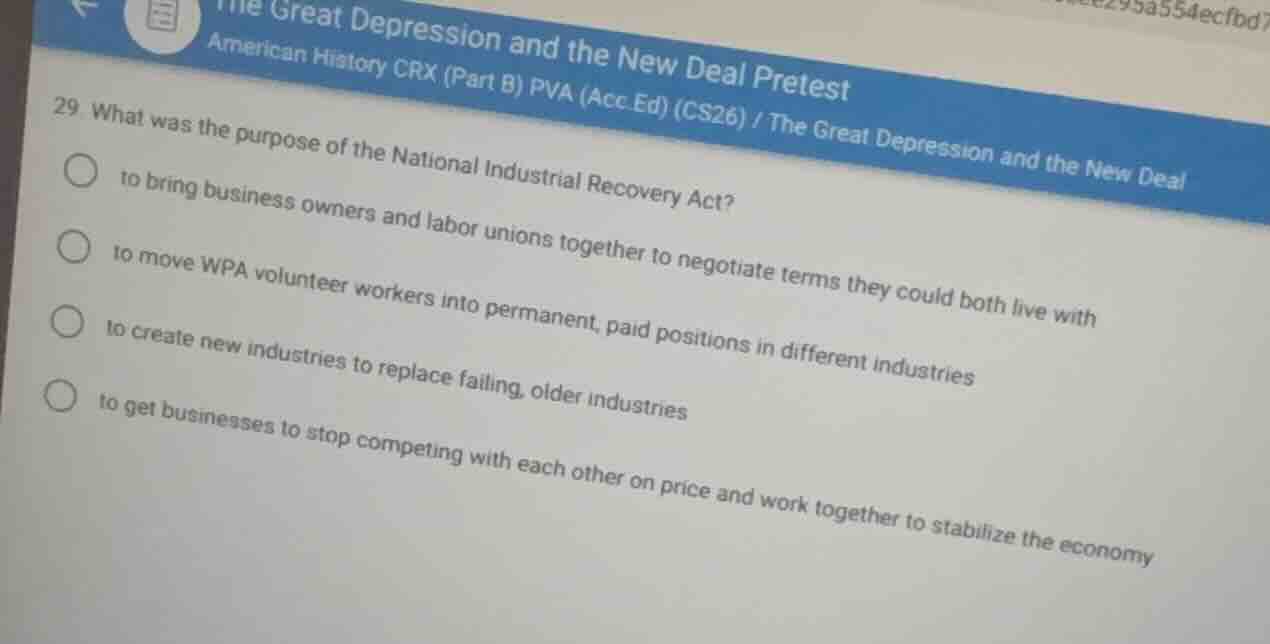
29. what was the purpose of the national industrial recovery act? to br…

Question

  1. what was the purpose of the national industrial recovery act?

to bring business owners and labor unions together to negotiate terms they could both live with
to move wpa volunteer workers into permanent, paid positions in different industries
to create new industries to replace failing, older industries
to get businesses to stop competing with each other on price and work together to stabilize the economy

Explanation:

Response

<pre_analysis>
{
"quality": "clear",
"question_count": 1,
"skills_matched": [
"direct_cot",
"multiple_choice_formatter",
"explain_then_answer",
"tutor"
],
"needs_drawing": false,
"concepts_used": [
"New Deal Legislation"
],
"new_concepts": [
"National Industrial Recovery Act",
"NIRA Industry Codes"
],
"current_concepts": [
"New Deal Legislation",
"National Industrial Recovery Act",
"NIRA Industry Codes"
]
}
</pre_analysis>

<reasoning>

Analyze the National Industrial Recovery Act

The National Industrial Recovery Act (NIRA) of 1933 was a cornerstone of President Franklin D. Roosevelt's New Deal. Its primary goal was to promote industrial recovery during the Great Depression.

Examine the mechanism of the NIRA

To achieve recovery, the NIRA established the National Recovery Administration (NRA). The NRA authorized businesses to write "codes of fair competition." These codes allowed industries to set price floors, limit production, and establish standardized working conditions.

Evaluate the core purpose

By allowing cooperative industry codes, the law suspended antitrust regulations. This encouraged businesses to stop destructive price-cutting competition and instead work together to stabilize prices, wages, and the overall economy.

Assess the given options

  • Option 1: "to bring business owners and labor unions together to negotiate terms they could both live with" — While Section 7(a) protected collective bargaining, this was not the overarching structural purpose of the entire act.
  • Option 2: "to move WPA volunteer workers into permanent, paid positions in different industries" — The WPA (Works Progress Administration) was created later in 1935 and is unrelated to the NIRA's purpose.
  • Option 3: "to create new industries to replace failing, older industries" — The NIRA aimed to stabilize and recover existing industries, not replace them with new ones.
  • Option 4: "to get businesses to stop competing with each other on price and work together to stabilize the economy" — This directly matches the NIRA's core mechanism of establishing codes of fair competition to halt deflationary price wars.

</reasoning>

<answer>
<mcq-option>(A) to bring business owners and labor unions together to negotiate terms they could both live with</mcq-option>
<mcq-option>(B) to move WPA volunteer workers into permanent, paid positions in different industries</mcq-option>
<mcq-option>(C) to create new industries to replace failing, older industries</mcq-option>
<mcq-correct>(D) to get businesses to stop competing with each other on price and work together to stabilize the economy</mcq-correct>
</answer>

<post_analysis>
{
"subject": "Social Science",
"question_type": "Multiple Choice",
"knowledge_point": [
"Social Science",
"US History",
"New Deal Legislation"
]
}
</post_analysis>

Answer:

<pre_analysis>
{
"quality": "clear",
"question_count": 1,
"skills_matched": [
"direct_cot",
"multiple_choice_formatter",
"explain_then_answer",
"tutor"
],
"needs_drawing": false,
"concepts_used": [
"New Deal Legislation"
],
"new_concepts": [
"National Industrial Recovery Act",
"NIRA Industry Codes"
],
"current_concepts": [
"New Deal Legislation",
"National Industrial Recovery Act",
"NIRA Industry Codes"
]
}
</pre_analysis>

<reasoning>

Analyze the National Industrial Recovery Act

The National Industrial Recovery Act (NIRA) of 1933 was a cornerstone of President Franklin D. Roosevelt's New Deal. Its primary goal was to promote industrial recovery during the Great Depression.

Examine the mechanism of the NIRA

To achieve recovery, the NIRA established the National Recovery Administration (NRA). The NRA authorized businesses to write "codes of fair competition." These codes allowed industries to set price floors, limit production, and establish standardized working conditions.

Evaluate the core purpose

By allowing cooperative industry codes, the law suspended antitrust regulations. This encouraged businesses to stop destructive price-cutting competition and instead work together to stabilize prices, wages, and the overall economy.

Assess the given options

  • Option 1: "to bring business owners and labor unions together to negotiate terms they could both live with" — While Section 7(a) protected collective bargaining, this was not the overarching structural purpose of the entire act.
  • Option 2: "to move WPA volunteer workers into permanent, paid positions in different industries" — The WPA (Works Progress Administration) was created later in 1935 and is unrelated to the NIRA's purpose.
  • Option 3: "to create new industries to replace failing, older industries" — The NIRA aimed to stabilize and recover existing industries, not replace them with new ones.
  • Option 4: "to get businesses to stop competing with each other on price and work together to stabilize the economy" — This directly matches the NIRA's core mechanism of establishing codes of fair competition to halt deflationary price wars.

</reasoning>

<answer>
<mcq-option>(A) to bring business owners and labor unions together to negotiate terms they could both live with</mcq-option>
<mcq-option>(B) to move WPA volunteer workers into permanent, paid positions in different industries</mcq-option>
<mcq-option>(C) to create new industries to replace failing, older industries</mcq-option>
<mcq-correct>(D) to get businesses to stop competing with each other on price and work together to stabilize the economy</mcq-correct>
</answer>

<post_analysis>
{
"subject": "Social Science",
"question_type": "Multiple Choice",
"knowledge_point": [
"Social Science",
"US History",
"New Deal Legislation"
]
}
</post_analysis>