QUESTION IMAGE
Question
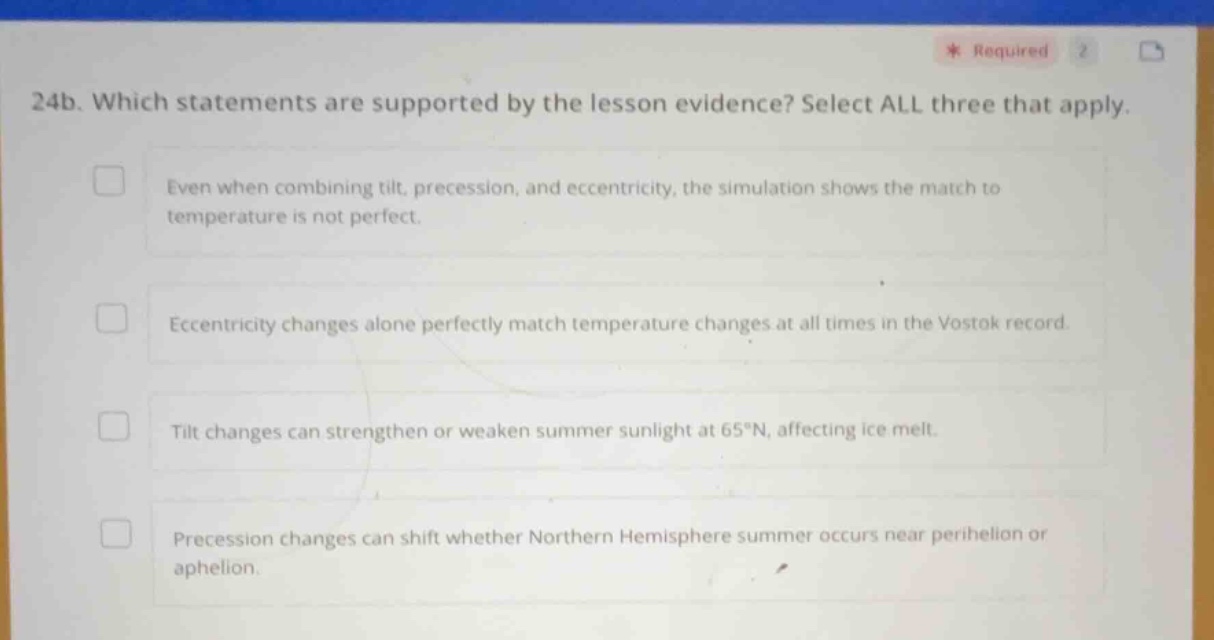
24b. which statements are supported by the lesson evidence? select all three that apply.
even when combining tilt, precession, and eccentricity, the simulation shows the match to temperature is not perfect.
eccentricity changes alone perfectly match temperature changes at all times in the vostok record.
tilt changes can strengthen or weaken summer sunlight at 65°n, affecting ice melt.
precession changes can shift whether northern hemisphere summer occurs near perihelion or aphelion.
Analyze the scientific validity of each statement
- Statement 1: "Even when combining tilt, precession, and eccentricity, the simulation shows the match to temperature is not perfect."
- This is scientifically accurate. While Milankovitch cycles (tilt, precession, eccentricity) drive long-term climate variations, other feedback mechanisms (like greenhouse gas concentrations and albedo changes) are required to fully explain historical temperature variations. Thus, the orbital simulation alone does not perfectly match the temperature record.
- Statement 2: "Eccentricity changes alone perfectly match temperature changes at all times in the Vostok record."
- This is incorrect. No single orbital parameter matches the temperature record perfectly on its own, especially not at all times.
- Statement 3: "Tilt changes can strengthen or weaken summer sunlight at \(65^\circ\text{N}\), affecting ice melt."
- This is correct. Milankovitch theory highlights that high-latitude summer insolation (specifically around \(65^\circ\text{N}\)) is critical for controlling the growth and decay of Northern Hemisphere ice sheets. Axial tilt directly affects the intensity of this seasonal sunlight.
- Statement 4: "Precession changes can shift whether Northern Hemisphere summer occurs near perihelion or aphelion."
- This is correct. Precession (the wobble of Earth's axis) alters the timing of the seasons relative to Earth's position in its elliptical orbit, determining whether summer in a given hemisphere occurs when Earth is closest to the Sun (perihelion) or farthest away (aphelion).

Snap & solve any problem in the app
Get step-by-step solutions on Sovi AI
Photo-based solutions with guided steps
Explore more problems and detailed explanations
- Even when combining tilt, precession, and eccentricity, the simulation shows the match to temperature is not perfect. (Correct answer)
- Eccentricity changes alone perfectly match temperature changes at all times in the Vostok record.
- Tilt changes can strengthen or weaken summer sunlight at 65°N, affecting ice melt. (Correct answer)
- Precession changes can shift whether Northern Hemisphere summer occurs near perihelion or aphelion. (Correct answer)