QUESTION IMAGE
Question
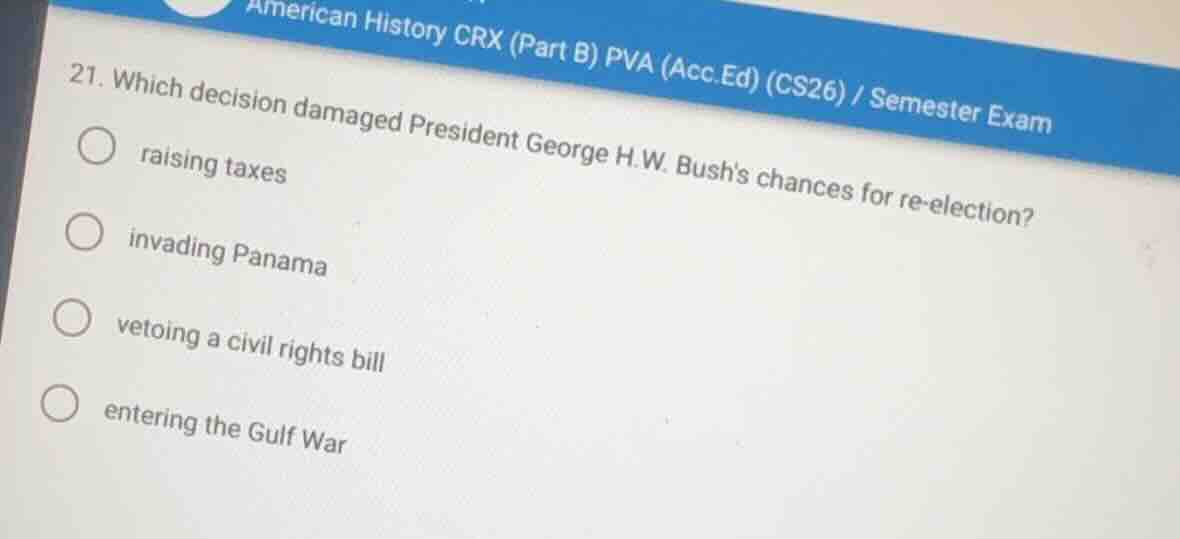
- which decision damaged president george h.w. bushs chances for re-election?
raising taxes
invading panama
vetoing a civil rights bill
entering the gulf war
<pre_analysis>
{
"quality": "clear",
"question_count": 1,
"skills_matched": [
"direct_cot",
"multiple_choice_formatter",
"explain_then_answer",
"tutor"
],
"needs_drawing": false,
"concepts_used": [],
"new_concepts": [
"George H.W. Bush Presidency",
"1992 Election",
"Read My Lips Pledge"
],
"current_concepts": [
"George H.W. Bush Presidency",
"1992 Election",
"Read My Lips Pledge"
]
}
</pre_analysis>
<reasoning>
Analyze the historical context of George H.W. Bush's presidency
During the 1988 Republican National Convention, George H.W. Bush made a famous campaign pledge: "Read my lips: no new taxes." This promise became a defining feature of his candidacy and helped secure his victory.
Evaluate the impact of the 1990 budget agreement
In 1990, facing a growing federal budget deficit, President Bush negotiated with the Democratic-controlled Congress. To reach a bipartisan budget agreement, he agreed to a compromise that included raising several existing taxes.
Assess the political consequences for the 1992 election
By agreeing to raise taxes, Bush directly violated his high-profile 1988 campaign pledge. This decision alienated conservative members of his own party, damaged his political credibility, and became a major point of attack for both his primary challenger, Pat Buchanan, and his Democratic opponent in the 1992 general election, Bill Clinton.
Compare other options
- Invading Panama (1989): This military action was generally popular with the American public and did not damage his re-election prospects.
- Vetoing a civil rights bill: While controversial, his veto of the Civil Rights Act of 1990 (which he later signed a modified version of in 1991) was not the primary driver of his loss.
- Entering the Gulf War (1991): This operation was highly successful and drove Bush's public approval ratings to historic highs near 90%, though this popularity faded as economic concerns took center stage.
</reasoning>
<answer>
<mcq-correct>raising taxes</mcq-correct>
<mcq-option>invading Panama</mcq-option>
<mcq-option>vetoing a civil rights bill</mcq-option>
<mcq-option>entering the Gulf War</mcq-option>
</answer>
<post_analysis>
{
"subject": "Social Science",
"question_type": "Multiple Choice",
"knowledge_point": [
"Social Science",
"History",
"George H.W. Bush Presidency"
]
}
</post_analysis>
Snap & solve any problem in the app
Get step-by-step solutions on Sovi AI
Photo-based solutions with guided steps
Explore more problems and detailed explanations
<pre_analysis>
{
"quality": "clear",
"question_count": 1,
"skills_matched": [
"direct_cot",
"multiple_choice_formatter",
"explain_then_answer",
"tutor"
],
"needs_drawing": false,
"concepts_used": [],
"new_concepts": [
"George H.W. Bush Presidency",
"1992 Election",
"Read My Lips Pledge"
],
"current_concepts": [
"George H.W. Bush Presidency",
"1992 Election",
"Read My Lips Pledge"
]
}
</pre_analysis>
<reasoning>
Analyze the historical context of George H.W. Bush's presidency
During the 1988 Republican National Convention, George H.W. Bush made a famous campaign pledge: "Read my lips: no new taxes." This promise became a defining feature of his candidacy and helped secure his victory.
Evaluate the impact of the 1990 budget agreement
In 1990, facing a growing federal budget deficit, President Bush negotiated with the Democratic-controlled Congress. To reach a bipartisan budget agreement, he agreed to a compromise that included raising several existing taxes.
Assess the political consequences for the 1992 election
By agreeing to raise taxes, Bush directly violated his high-profile 1988 campaign pledge. This decision alienated conservative members of his own party, damaged his political credibility, and became a major point of attack for both his primary challenger, Pat Buchanan, and his Democratic opponent in the 1992 general election, Bill Clinton.
Compare other options
- Invading Panama (1989): This military action was generally popular with the American public and did not damage his re-election prospects.
- Vetoing a civil rights bill: While controversial, his veto of the Civil Rights Act of 1990 (which he later signed a modified version of in 1991) was not the primary driver of his loss.
- Entering the Gulf War (1991): This operation was highly successful and drove Bush's public approval ratings to historic highs near 90%, though this popularity faded as economic concerns took center stage.
</reasoning>
<answer>
<mcq-correct>raising taxes</mcq-correct>
<mcq-option>invading Panama</mcq-option>
<mcq-option>vetoing a civil rights bill</mcq-option>
<mcq-option>entering the Gulf War</mcq-option>
</answer>
<post_analysis>
{
"subject": "Social Science",
"question_type": "Multiple Choice",
"knowledge_point": [
"Social Science",
"History",
"George H.W. Bush Presidency"
]
}
</post_analysis>