QUESTION IMAGE
Question
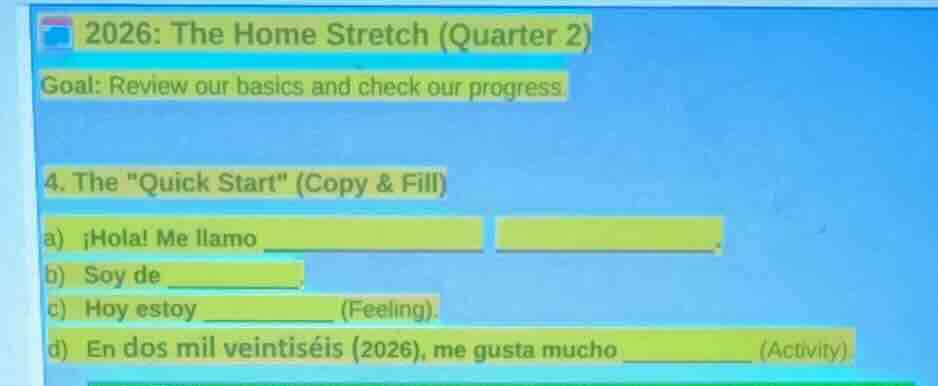
2026: the home stretch (quarter 2)
goal: review our basics and check our progress
- the \quick start\ (copy & fill)
a) ¡hola! me llamo ____ ____.
b) soy de ______.
c) hoy estoy ______ (feeling).
d) en dos mil veintiséis (2026), me gusta mucho ______ (activity)
To solve this "Quick Start" activity (which is a Spanish language - related task), we can fill in the blanks with appropriate Spanish words based on common phrases and vocabulary:
Part a)
The phrase "¡Hola! Me llamo" is used to introduce oneself, meaning "Hello! My name is". So we can fill in a first name and a last name (or just a name). For example, "¡Hola! Me llamo Juan Pérez."
Part b)
"Soy de" is used to say where one is from. We can fill in a place, like a city, country, or region. For example, "Soy de México."
Part c)
"Hoy estoy" is followed by an adjective describing a feeling. Some common feeling adjectives in Spanish are "feliz" (happy), "triste" (sad), "cansado" (tired - masculine form), "cansada" (tired - feminine form), "enojado" (angry - masculine form), "enojada" (angry - feminine form), etc. For example, "Hoy estoy feliz."
Part d)
"Me gusta mucho" is followed by an activity (a verb in the infinitive form or a noun representing an activity). Some examples of activities: "leer" (to read), "escribir" (to write), "jugar fútbol" (to play soccer), "pintar" (to paint), etc. For example, "En dos mil veintiséis (2026), me gusta mucho leer."
These are just sample answers, and you can use other appropriate Spanish words based on your own situation or preferences.
Final Answers (Sample)
a) ¡Hola! Me llamo \(\boldsymbol{Juan}\) \(\boldsymbol{Pérez}\).
b) Soy de \(\boldsymbol{México}\).
c) Hoy estoy \(\boldsymbol{feliz}\) (Feeling).
d) En dos mil veintiséis (2026), me gusta mucho \(\boldsymbol{leer}\) (Activity).

Snap & solve any problem in the app
Get step-by-step solutions on Sovi AI
Photo-based solutions with guided steps
Explore more problems and detailed explanations
To solve this "Quick Start" activity (which is a Spanish language - related task), we can fill in the blanks with appropriate Spanish words based on common phrases and vocabulary:
Part a)
The phrase "¡Hola! Me llamo" is used to introduce oneself, meaning "Hello! My name is". So we can fill in a first name and a last name (or just a name). For example, "¡Hola! Me llamo Juan Pérez."
Part b)
"Soy de" is used to say where one is from. We can fill in a place, like a city, country, or region. For example, "Soy de México."
Part c)
"Hoy estoy" is followed by an adjective describing a feeling. Some common feeling adjectives in Spanish are "feliz" (happy), "triste" (sad), "cansado" (tired - masculine form), "cansada" (tired - feminine form), "enojado" (angry - masculine form), "enojada" (angry - feminine form), etc. For example, "Hoy estoy feliz."
Part d)
"Me gusta mucho" is followed by an activity (a verb in the infinitive form or a noun representing an activity). Some examples of activities: "leer" (to read), "escribir" (to write), "jugar fútbol" (to play soccer), "pintar" (to paint), etc. For example, "En dos mil veintiséis (2026), me gusta mucho leer."
These are just sample answers, and you can use other appropriate Spanish words based on your own situation or preferences.
Final Answers (Sample)
a) ¡Hola! Me llamo \(\boldsymbol{Juan}\) \(\boldsymbol{Pérez}\).
b) Soy de \(\boldsymbol{México}\).
c) Hoy estoy \(\boldsymbol{feliz}\) (Feeling).
d) En dos mil veintiséis (2026), me gusta mucho \(\boldsymbol{leer}\) (Activity).