QUESTION IMAGE
Question
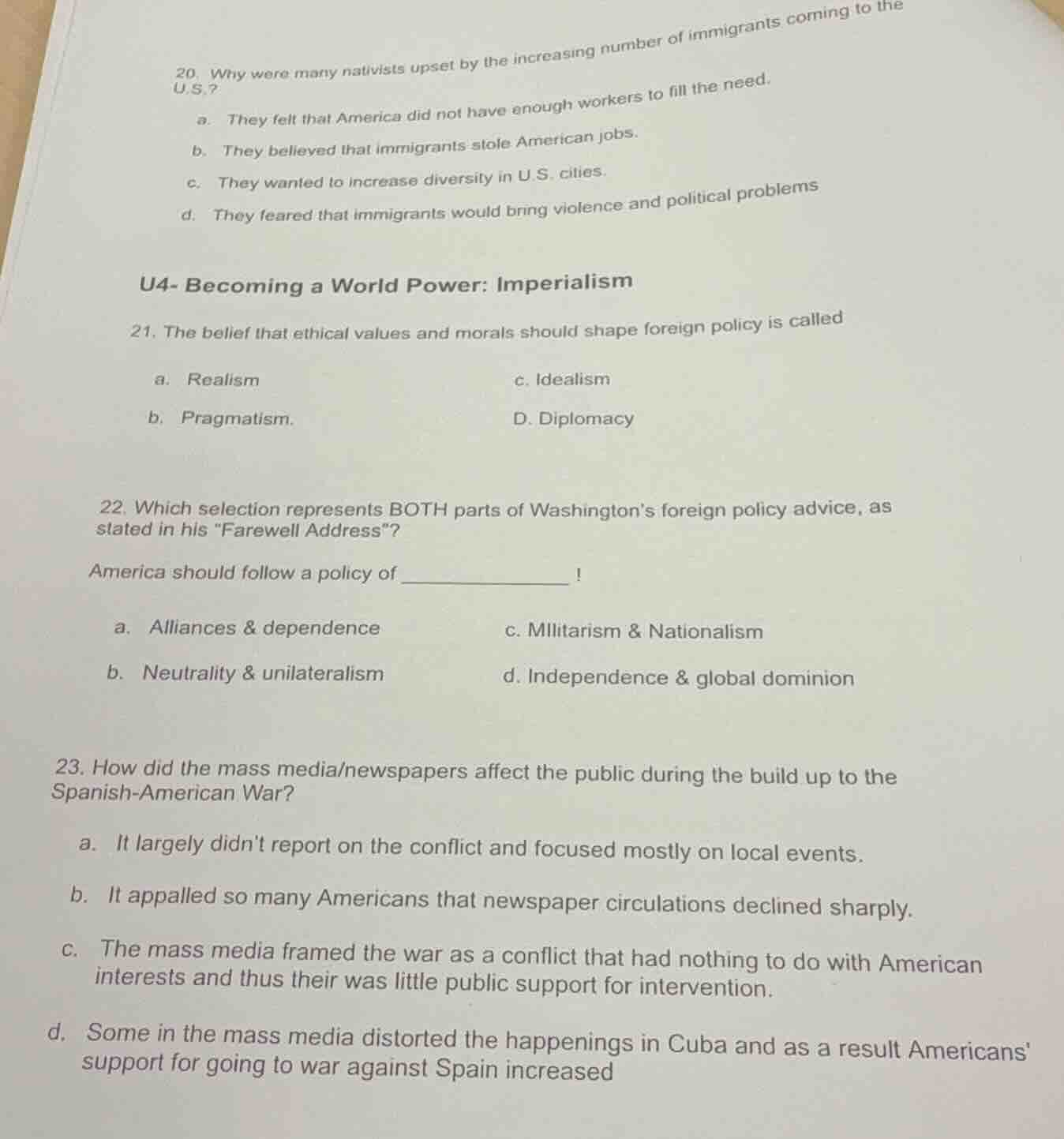
- why were many nativists upset by the increasing number of immigrants coming to the u.s.?
a. they felt that america did not have enough workers to fill the need.
b. they believed that immigrants stole american jobs.
c. they wanted to increase diversity in u.s. cities.
d. they feared that immigrants would bring violence and political problems
u4- becoming a world power: imperialism
- the belief that ethical values and morals should shape foreign policy is called
a. realism \t\t\tc. idealism
b. pragmatism. \t\t\td. diplomacy
- which selection represents both parts of washington’s foreign policy advice, as stated in his \farewell address\?
america should follow a policy of _____________!
a. alliances & dependence \t\t\tc. militarism & nationalism
b. neutrality & unilateralism \t\t\td. independence & global dominion
- how did the mass media/newspapers affect the public during the build up to the spanish - american war?
a. it largely didnt report on the conflict and focused mostly on local events.
b. it appalled so many americans that newspaper circulations declined sharply.
c. the mass media framed the war as a conflict that had nothing to do with american interests and thus their was little public support for intervention.
d. some in the mass media distorted the happenings in cuba and as a result americans support for going to war against spain increased
- Nativists held anti-immigrant views, often fearing immigrants would take jobs from native-born Americans and bring social unrest.
- Idealism in foreign policy prioritizes ethical and moral principles as the foundation for policy decisions, unlike realism (focused on power) or pragmatism (focused on practical outcomes).
- George Washington's Farewell Address emphasized avoiding foreign alliances and maintaining neutrality, advocating for unilateral, non-interventionist foreign policy.
- Yellow journalism (sensationalized, distorted reporting) by newspapers during the lead-up to the Spanish-American War stoked public anger and support for U.S. intervention in Cuba.

Snap & solve any problem in the app
Get step-by-step solutions on Sovi AI
Photo-based solutions with guided steps
Explore more problems and detailed explanations
- b. They believed that immigrants stole American jobs.
d. They feared that immigrants would bring violence and political problems
- c. Idealism
- b. Neutrality & unilateralism
- d. Some in the mass media distorted the happenings in Cuba and as a result Americans' support for going to war against Spain increased