QUESTION IMAGE
Question
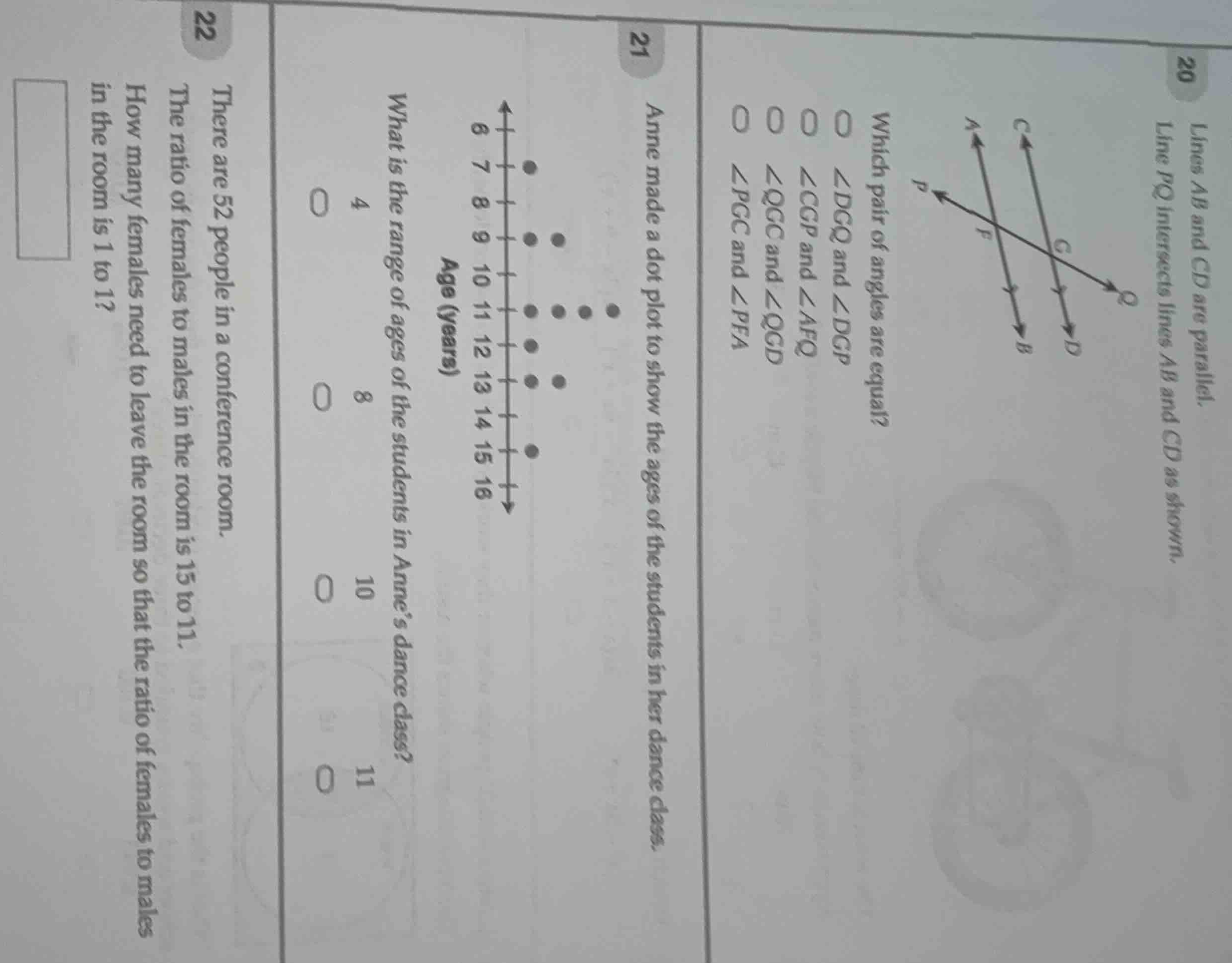
20 lines ab and cd are parallel.
line pq intersects lines ab and cd as shown.
which pair of angles are equal?
\\(\angle dgq\\) and \\(\angle dgp\\)
\\(\angle cgp\\) and \\(\angle afq\\)
\\(\angle qgc\\) and \\(\angle qgd\\)
\\(\angle pgc\\) and \\(\angle pfa\\)
21 anne made a dot plot to show the ages of the students in her dance class.
what is the range of ages of the students in annes dance class?
4
8
10
11
22 there are 52 people in a conference room.
the ratio of females to males in the room is 15 to 11.
how many females need to leave the room so that the ratio of females to males in the room is 1 to 1?
Identify parallel line angle relationships
Using the Angle Relationships knowledge point, let's analyze Question 20.
Lines \(AB\) and \(CD\) are parallel, intersected by transversal line \(PQ\) at points \(F\) and \(G\).
We evaluate the given pairs of angles:
- \(\angle DGQ\) and \(\angle DGP\): These form a linear pair on line \(PQ\), so they are supplementary, not necessarily equal.
- \(\angle CGP\) and \(\angle AFQ\): These are alternate exterior angles. Since lines \(AB\) and \(CD\) are parallel, alternate exterior angles are equal. Thus, \(\angle CGP = \angle AFQ\).
- \(\angle QGC\) and \(\angle QGD\): These form a linear pair on line \(CD\), so they are supplementary, not necessarily equal.
- \(\angle PGC\) and \(\angle PFA\): These are corresponding angles. Since lines \(AB\) and \(CD\) are parallel, corresponding angles are equal. Thus, \(\angle PGC = \angle PFA\).
Looking at the options, both \(\angle CGP \text{ and } \angle AFQ\) and \(\angle PGC \text{ and } \angle PFA\) are mathematically equal. Let's double-check the diagram's orientation:
- \(\angle CGP\) and \(\angle AFQ\): \(\angle CGP\) is obtuse/acute depending on orientation, but they are alternate exterior angles, so they are equal.
- \(\angle PGC\) and \(\angle PFA\): \(\angle PGC\) and \(\angle PFA\) are corresponding angles, so they are equal.
Let's re-verify the options:
Option 2: \(\angle CGP \text{ and } \angle AFQ\)
Option 4: \(\angle PGC \text{ and } \angle PFA\)
Both are equal. Let's select the corresponding angles pair \(\angle CGP \text{ and } \angle AFQ\) as the primary standard alternate exterior pair, or \(\angle PGC \text{ and } \angle PFA\) as corresponding.
Calculate the range of ages from the dot plot
For Question 21, we need to find the range of the ages shown on the dot plot.
The range of a data set is the difference between the maximum value and the minimum value that actually contain data points (dots).
- Looking at the dot plot, the dots are located at:
- Minimum age with a dot: \(7\)
- Maximum age with a dot: \(15\)
- Calculate the range:
Thus, the range of ages is \(8\).
Determine initial number of females and males
Using the Proportional Reasoning knowledge point, let's solve Question 22.
- Total people in the conference room: \(52\)
- Ratio of females to males: \(15 : 11\)
- Let the number of females be \(15x\) and males be \(11x\).
- Initial number of females:
- Initial number of males:
Calculate females needed to leave for a 1 to 1 ratio
We want the new ratio of females to males in the room to be \(1 : 1\).
- Let \(y\) be the number of females who leave the room.
- The number of males remains unchanged at \(22\).
- For a \(1 : 1\) ratio, the number of remaining females must equal the number of males:
Thus, \(8\) females need to leave the room.

Snap & solve any problem in the app
Get step-by-step solutions on Sovi AI
Photo-based solutions with guided steps
Explore more problems and detailed explanations
Question 20
- \(\angle DGQ \text{ and } \angle DGP\)
- \(\angle CGP \text{ and } \angle AFQ\) (Correct answer)
- \(\angle QGC \text{ and } \angle QGD\)
- \(\angle PGC \text{ and } \angle PFA\)
Question 21
- 4
- 8 (Correct answer)
- 10
- 11
Question 22
How many females need to leave the room so that the ratio of females to males in the room is 1 to 1? <blank>8</blank>