QUESTION IMAGE
Question
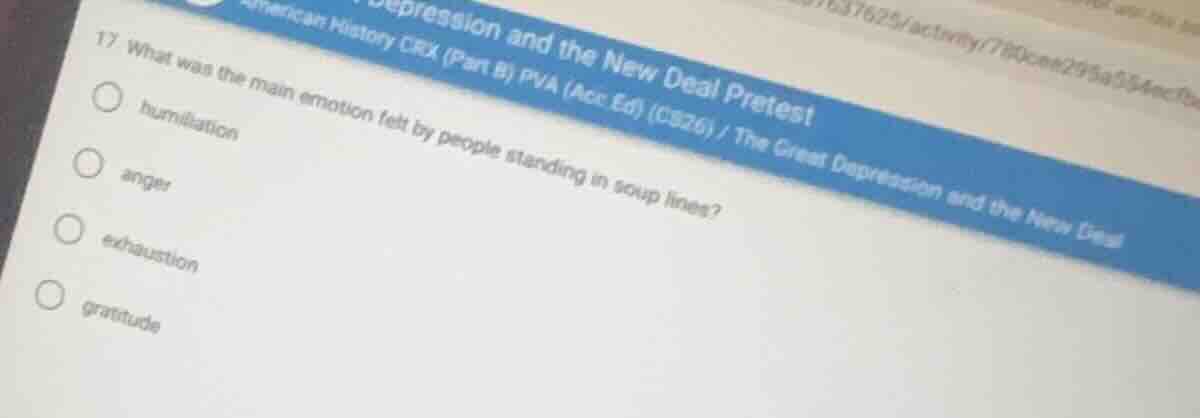
- what was the main emotion felt by people standing in soup lines?
humiliation
anger
exhaustion
gratitude
<pre_analysis>
{
"quality": "clear",
"question_count": 1,
"skills_matched": [
"direct_cot",
"multiple_choice_formatter",
"explain_then_answer",
"tutor"
],
"needs_drawing": false,
"concepts_used": [],
"new_concepts": [
"Great Depression Culture",
"Soup Kitchens"
],
"current_concepts": [
"Great Depression Culture",
"Soup Kitchens"
]
}
</pre_analysis>
<reasoning>
Analyze the historical context of soup lines
During the Great Depression, millions of self-reliant Americans lost their jobs, savings, and homes. Relying on public charity or soup lines was widely documented in personal accounts and historical analyses as a deeply painful experience.
Evaluate the psychological impact on individuals
For many workers accustomed to providing for their families, standing in public lines for free food was viewed as a public admission of personal failure. This reliance on charity stripped away their sense of independence and self-respect.
Identify the primary emotion described in historical records
Historical narratives and textbooks consistently emphasize that the overriding emotion felt by those in breadlines and soup lines was shame and humiliation, rather than anger, exhaustion, or gratitude.
</reasoning>
<answer>
<mcq-correct>humiliation</mcq-correct>
<mcq-option>anger</mcq-option>
<mcq-option>exhaustion</mcq-option>
<mcq-option>gratitude</mcq-option>
</answer>
<post_analysis>
{
"subject": "Social Science",
"question_type": "Multiple Choice",
"knowledge_point": [
"Social Science",
"History",
"Great Depression Culture"
]
}
</post_analysis>
Snap & solve any problem in the app
Get step-by-step solutions on Sovi AI
Photo-based solutions with guided steps
Explore more problems and detailed explanations
<pre_analysis>
{
"quality": "clear",
"question_count": 1,
"skills_matched": [
"direct_cot",
"multiple_choice_formatter",
"explain_then_answer",
"tutor"
],
"needs_drawing": false,
"concepts_used": [],
"new_concepts": [
"Great Depression Culture",
"Soup Kitchens"
],
"current_concepts": [
"Great Depression Culture",
"Soup Kitchens"
]
}
</pre_analysis>
<reasoning>
Analyze the historical context of soup lines
During the Great Depression, millions of self-reliant Americans lost their jobs, savings, and homes. Relying on public charity or soup lines was widely documented in personal accounts and historical analyses as a deeply painful experience.
Evaluate the psychological impact on individuals
For many workers accustomed to providing for their families, standing in public lines for free food was viewed as a public admission of personal failure. This reliance on charity stripped away their sense of independence and self-respect.
Identify the primary emotion described in historical records
Historical narratives and textbooks consistently emphasize that the overriding emotion felt by those in breadlines and soup lines was shame and humiliation, rather than anger, exhaustion, or gratitude.
</reasoning>
<answer>
<mcq-correct>humiliation</mcq-correct>
<mcq-option>anger</mcq-option>
<mcq-option>exhaustion</mcq-option>
<mcq-option>gratitude</mcq-option>
</answer>
<post_analysis>
{
"subject": "Social Science",
"question_type": "Multiple Choice",
"knowledge_point": [
"Social Science",
"History",
"Great Depression Culture"
]
}
</post_analysis>