QUESTION IMAGE
Question
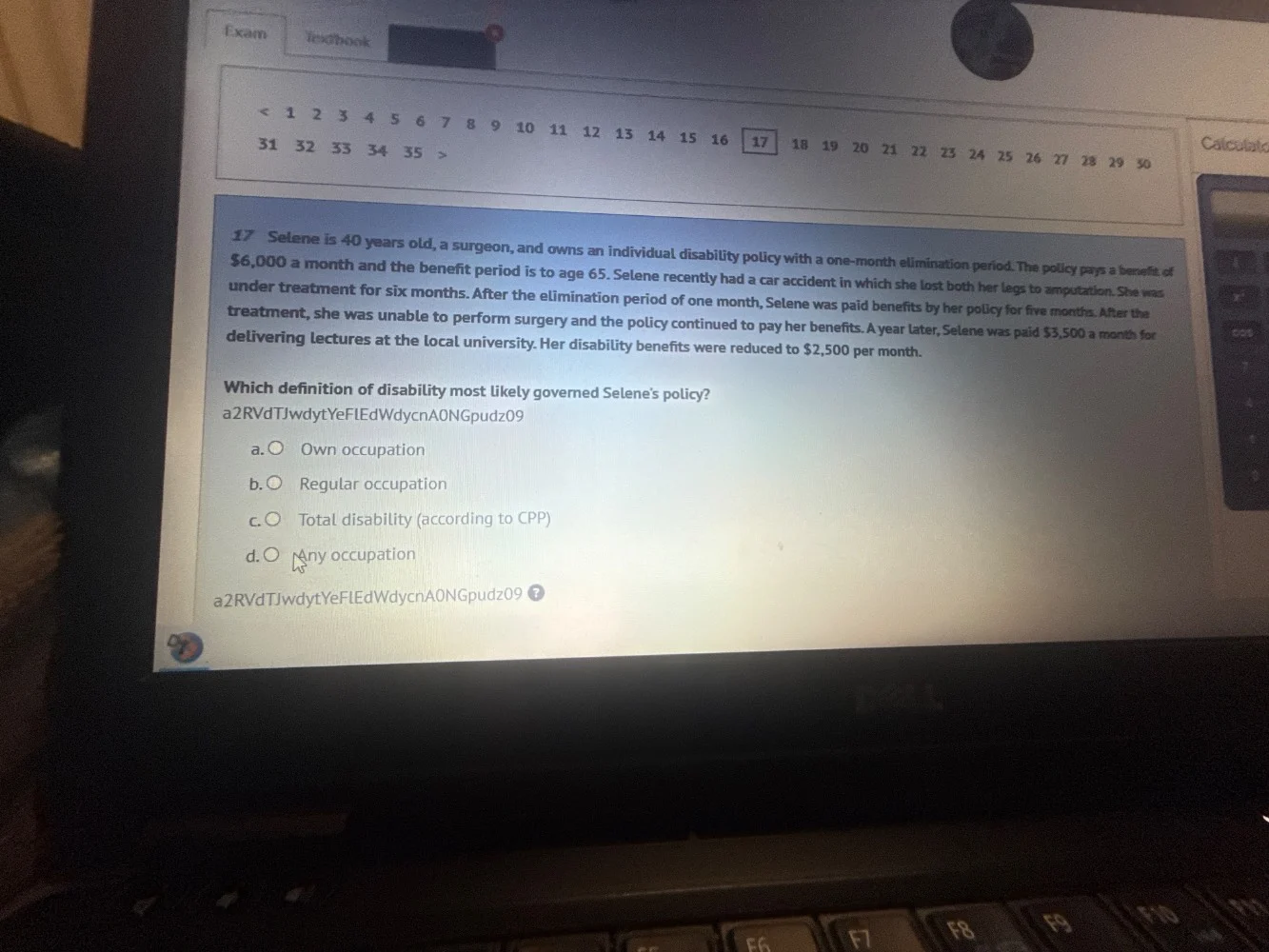
17 selene is 40 years old, a surgeon, and owns an individual disability policy with a one - month elimination period. the policy pays a benefit of $6,000 a month and the benefit period is to age 65. selene recently had a car accident in which she lost both her legs to amputation. she was under treatment for six months. after the elimination period of one month, selene was paid benefits by her policy for five months. after the treatment, she was unable to perform surgery and the policy continued to pay her benefits. a year later, selene was paid $3,500 a month for delivering lectures at the local university. her disability benefits were reduced to $2,500 per month.
which definition of disability most likely governed selene’s policy?
a2rvdtjwdytyefledwdycna0ngpudz09
a. own occupation
b. regular occupation
c. total disability (according to cpp)
d. any occupation
a2rvdtjwdytyefledwdycna0ngpudz09
To determine the disability definition governing Selene’s policy, we analyze each option:
- Option a (Own occupation): This definition considers disability as being unable to perform one’s own (original) occupation. Selene, a surgeon, couldn’t perform surgery (her own occupation) after amputation, but she could work as a lecturer. The policy continued benefits (and reduced them based on her new income), which aligns with “own occupation” (she’s disabled from her original job, so benefits apply, with offset for other income).
- Option b (Regular occupation): Not a standard disability definition in this context; “own occupation” or “any occupation” are more common.
- Option c (Total disability - CPP): CPP total disability requires inability to perform any substantial gainful activity, but Selene works as a lecturer, so this doesn’t fit.
- Option d (Any occupation): This would require inability to work in any job, but Selene works as a lecturer, so she wouldn’t qualify for benefits under “any occupation.”

Snap & solve any problem in the app
Get step-by-step solutions on Sovi AI
Photo-based solutions with guided steps
Explore more problems and detailed explanations
a. Own occupation