QUESTION IMAGE
Question
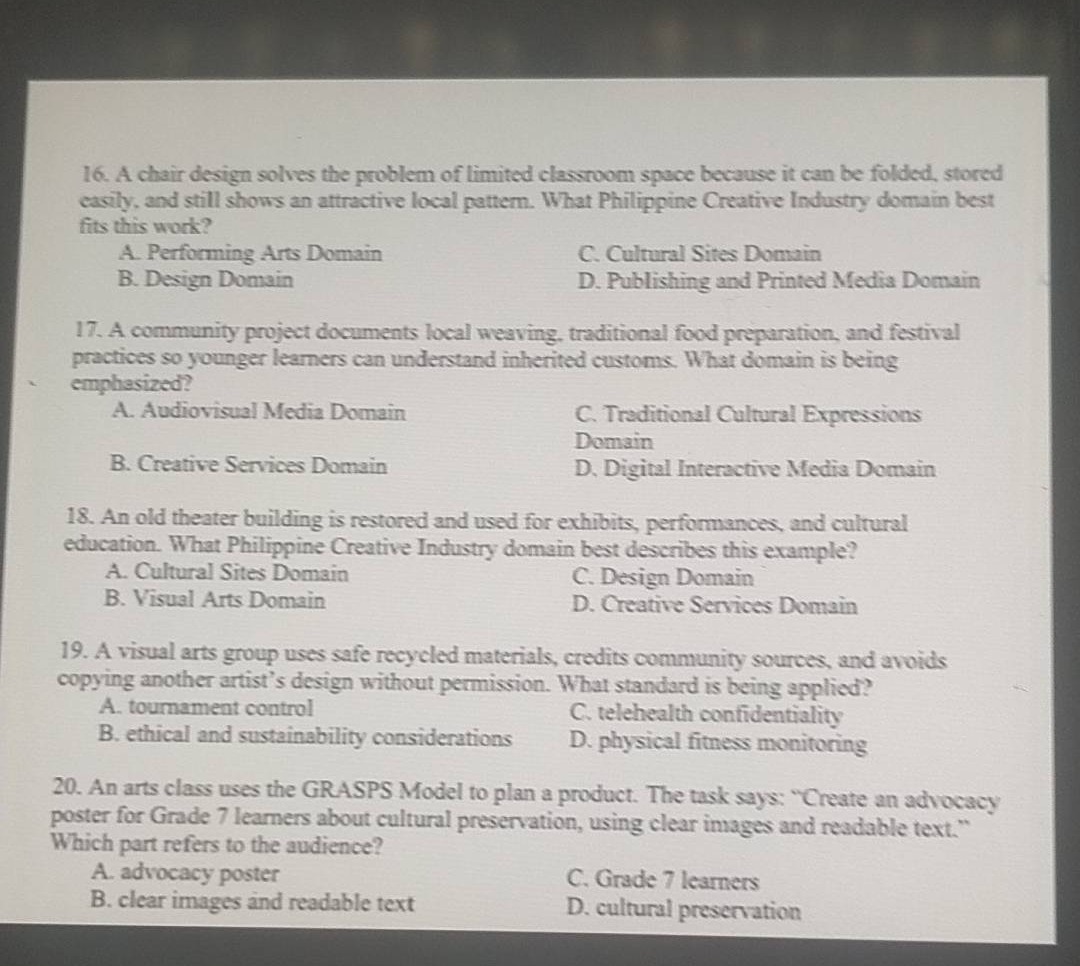
- a chair design solves the problem of limited classroom space because it can be folded, stored easily, and still shows an attractive local pattern. what philippine creative industry domain best fits this work?
a. performing arts domain
b. design domain
c. cultural sites domain
d. publishing and printed media domain
- a community project documents local weaving, traditional food preparation, and festival practices so younger learners can understand inherited customs. what domain is being emphasized?
a. audiovisual media domain
b. creative services domain
c. traditional cultural expressions domain
d. digital interactive media domain
- an old theater building is restored and used for exhibits, performances, and cultural education. what philippine creative industry domain best describes this example?
a. cultural sites domain
b. visual arts domain
c. design domain
d. creative services domain
- a visual arts group uses safe recycled materials, credits community sources, and avoids copying another artists design without permission. what standard is being applied?
a. tournament control
b. ethical and sustainability considerations
c. telehealth confidentiality
d. physical fitness monitoring
- an arts class uses the grasps model to plan a product. the task says: \create an advocacy poster for grade 7 learners about cultural preservation, using clear images and readable text.\ which part refers to the audience?
a. advocacy poster
b. clear images and readable text
c. grade 7 learners
d. cultural preservation
🆕 New Concept Discovered: Philippine Creative Industries & GRASPS Model
Classifying creative sectors and defining performance task components.
Step 1: Analyze Question 16
The question asks about a "chair design" that solves a space problem and features a local pattern. Under the Philippine Creative Industries Development Act (PCIDA), industrial, product, and furniture designs fall directly under the Design Domain.
- Correct Option: B. Design Domain
Step 2: Analyze Question 17
The project documents "local weaving, traditional food preparation, and festival practices" to pass down inherited customs. These activities represent intangible cultural heritage and traditional craftsmanship, which belong to the Traditional Cultural Expressions Domain.
- Correct Option: C. Traditional Cultural Expressions Domain
Step 3: Analyze Question 18
An "old theater building is restored and used for exhibits, performances, and cultural education." Historic buildings, monuments, and physical heritage spaces fall under the Cultural Sites Domain.
- Correct Option: A. Cultural Sites Domain
Step 4: Analyze Question 19
The group uses "safe recycled materials" (sustainability) and "avoids copying another artist's design without permission" (ethics/intellectual property). This directly aligns with ethical and sustainability considerations.
- Correct Option: B. ethical and sustainability considerations
Step 5: Analyze Question 20
The GRASPS model stands for:
- Goal
- Role
- Audience
- Situation
- Product
- Standards
In the prompt: "Create an advocacy poster [Product] for Grade 7 learners [Audience] about cultural preservation [Goal/Situation]..."
The target group receiving or viewing the product is the Grade 7 learners.
- Correct Option: C. Grade 7 learners

Snap & solve any problem in the app
Get step-by-step solutions on Sovi AI
Photo-based solutions with guided steps
Explore more problems and detailed explanations
- B. Design Domain
- C. Traditional Cultural Expressions Domain
- A. Cultural Sites Domain
- B. ethical and sustainability considerations
- C. Grade 7 learners