QUESTION IMAGE
Question
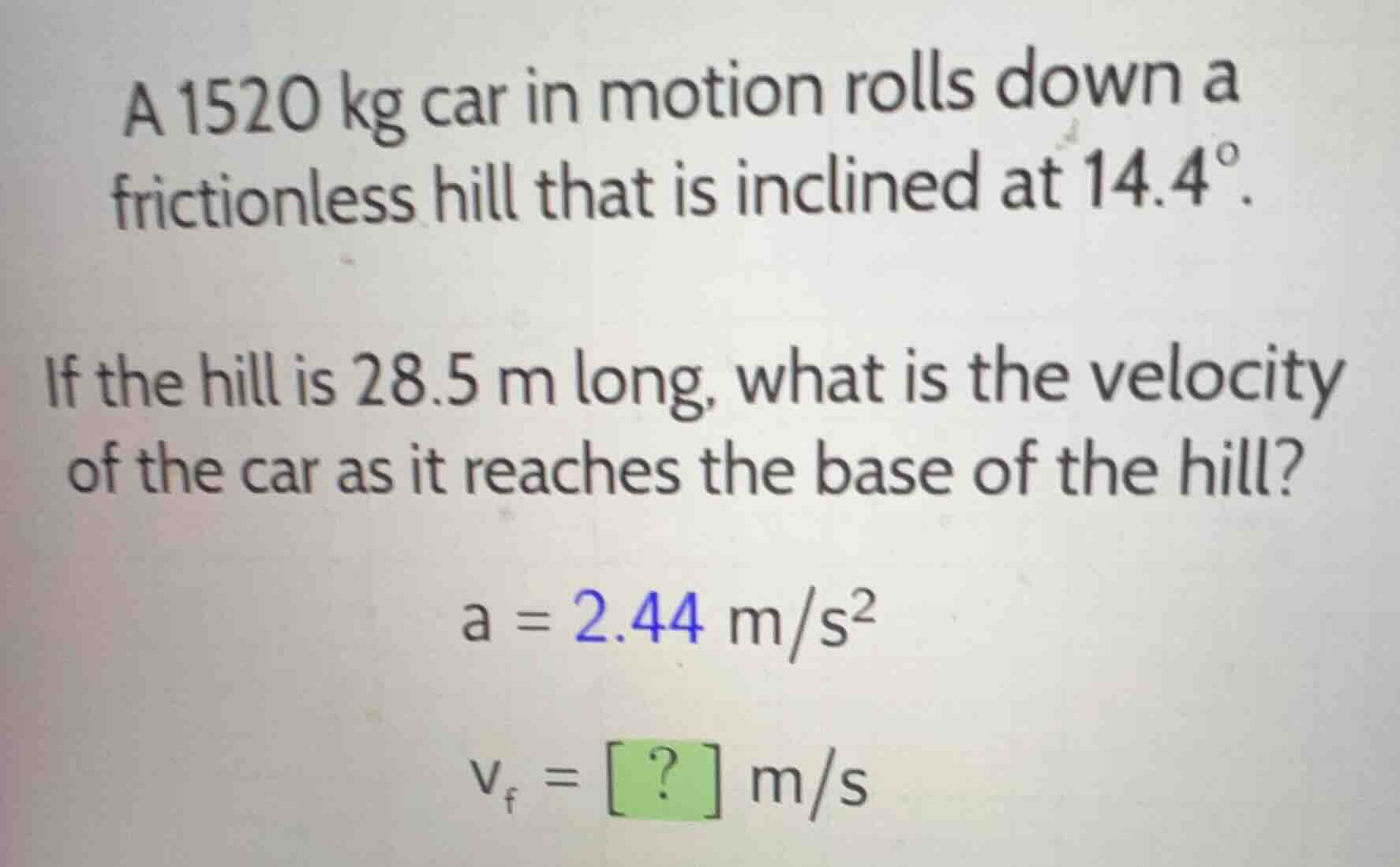
a 1520 kg car in motion rolls down a frictionless hill that is inclined at \\(14.4^{\circ}\\).
if the hill is 28.5 m long, what is the velocity of the car as it reaches the base of the hill?
\\a = 2.44\text{ m/s}^2\\
\\v_{\text{f}} = ?\text{ m/s}\\
🆕 New Concept Discovered: Conservation of Energy or Kinematics on an Incline
Using motion equations to find final velocity.
Step 1: Identify given values
The problem provides the following values:
- Mass of the car, \( m = 1520\text{ kg} \) (not needed for kinematics)
- Acceleration down the incline, \( a = 2.44\text{ m/s}^2 \)
- Distance along the incline, \( d = 28.5\text{ m} \)
- Initial velocity, \( v_i = 0\text{ m/s} \) (since it "rolls down" starting from rest)
Step 2: Select the kinematic equation
To find the final velocity \( v_f \) when acceleration \( a \), distance \( d \), and initial velocity \( v_i \) are known, we use:
Step 3: Calculate the final velocity
Substitute the known values into the equation:
Rounding to three significant figures gives:

Snap & solve any problem in the app
Get step-by-step solutions on Sovi AI
Photo-based solutions with guided steps
Explore more problems and detailed explanations
11.8