QUESTION IMAGE
Question
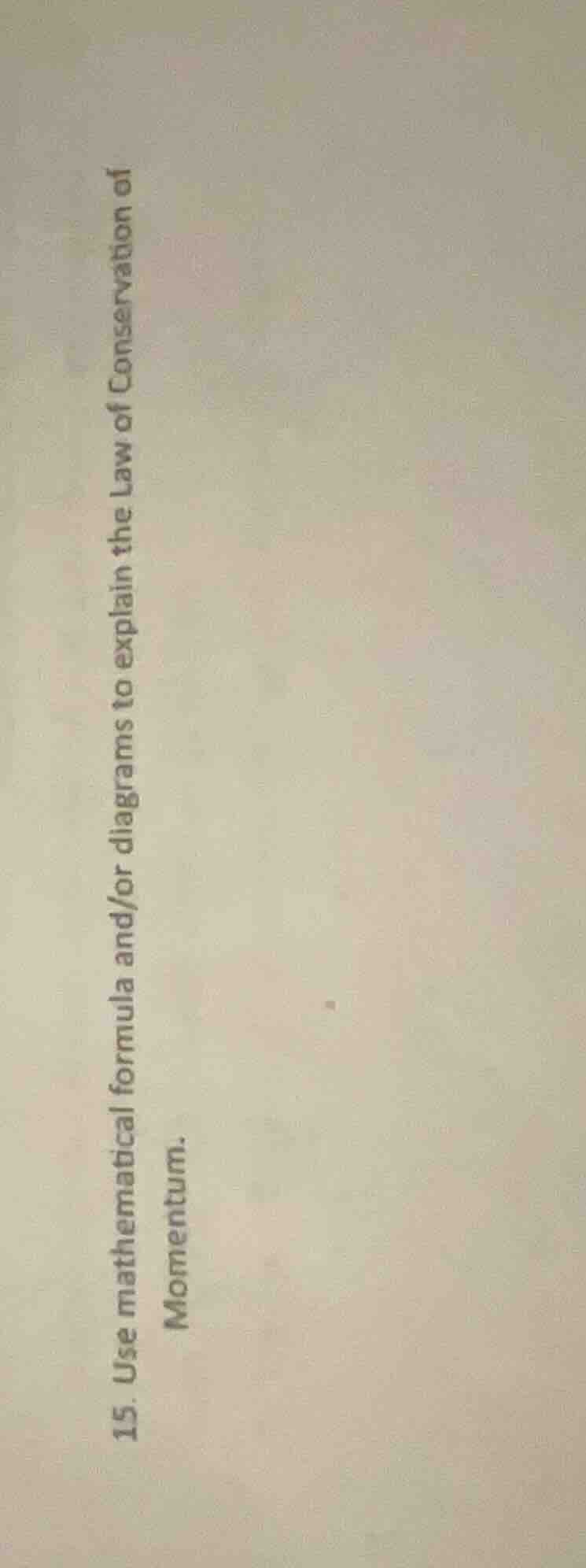
- use mathematical formula and/or diagrams to explain the law of conservation of momentum.
<pre_analysis>
{
"quality": "clear",
"question_count": 1,
"skills_matched": [
"step_cot",
"explain_then_answer",
"quick"
],
"needs_drawing": false,
"concepts_used": [
"Newtonian Mechanics"
],
"new_concepts": [
"Conservation of Momentum"
],
"current_concepts": [
"Newtonian Mechanics",
"Conservation of Momentum"
]
}
</pre_analysis>
<reasoning>
Relate Newton's Third Law to interacting forces
\[
\vec{F}_{12} = -\vec{F}_{21}
\]
Apply Newton's Second Law in terms of momentum
\[
\vec{F}_{12} = \frac{d\vec{p}_1}{dt}, \quad \vec{F}_{21} = \frac{d\vec{p}_2}{dt}
\]
Integrate to show total momentum conservation
\[
\frac{d\vec{p}_1}{dt} + \frac{d\vec{p}_2}{dt} = 0 \implies \frac{d}{dt}(\vec{p}_1 + \vec{p}_2) = 0 \implies \vec{p}_{\text{total}} = \text{constant}
\]
</reasoning>
<answer>
According to Newton's Third Law, when two bodies interact in an isolated system, the force exerted by body 1 on body 2 (\(\vec{F}_{21}\)) is equal in magnitude and opposite in direction to the force exerted by body 2 on body 1 (\(\vec{F}_{12}\)):
\[
\vec{F}_{12} = -\vec{F}_{21}
\]
Using Newton's Second Law, force is defined as the rate of change of momentum (\(\vec{F} = \frac{d\vec{p}}{dt}\)):
\[
\frac{d\vec{p}_1}{dt} = -\frac{d\vec{p}_2}{dt}
\]
Rearranging this equation gives:
\[
\frac{d\vec{p}_1}{dt} + \frac{d\vec{p}_2}{dt} = 0 \implies \frac{d}{dt}(\vec{p}_1 + \vec{p}_2) = 0
\]
Since the time derivative of the total momentum is zero, the total momentum of the system remains constant:
\[
\vec{p}_1 + \vec{p}_2 = \text{constant}
\]
</answer>
<post_analysis>
{
"subject": "Natural Science",
"question_type": "Free Response",
"knowledge_point": [
"Natural Science",
"Physics",
"Conservation of Momentum"
]
}
</post_analysis>
Snap & solve any problem in the app
Get step-by-step solutions on Sovi AI
Photo-based solutions with guided steps
Explore more problems and detailed explanations
<pre_analysis>
{
"quality": "clear",
"question_count": 1,
"skills_matched": [
"step_cot",
"explain_then_answer",
"quick"
],
"needs_drawing": false,
"concepts_used": [
"Newtonian Mechanics"
],
"new_concepts": [
"Conservation of Momentum"
],
"current_concepts": [
"Newtonian Mechanics",
"Conservation of Momentum"
]
}
</pre_analysis>
<reasoning>
Relate Newton's Third Law to interacting forces
\[
\vec{F}_{12} = -\vec{F}_{21}
\]
Apply Newton's Second Law in terms of momentum
\[
\vec{F}_{12} = \frac{d\vec{p}_1}{dt}, \quad \vec{F}_{21} = \frac{d\vec{p}_2}{dt}
\]
Integrate to show total momentum conservation
\[
\frac{d\vec{p}_1}{dt} + \frac{d\vec{p}_2}{dt} = 0 \implies \frac{d}{dt}(\vec{p}_1 + \vec{p}_2) = 0 \implies \vec{p}_{\text{total}} = \text{constant}
\]
</reasoning>
<answer>
According to Newton's Third Law, when two bodies interact in an isolated system, the force exerted by body 1 on body 2 (\(\vec{F}_{21}\)) is equal in magnitude and opposite in direction to the force exerted by body 2 on body 1 (\(\vec{F}_{12}\)):
\[
\vec{F}_{12} = -\vec{F}_{21}
\]
Using Newton's Second Law, force is defined as the rate of change of momentum (\(\vec{F} = \frac{d\vec{p}}{dt}\)):
\[
\frac{d\vec{p}_1}{dt} = -\frac{d\vec{p}_2}{dt}
\]
Rearranging this equation gives:
\[
\frac{d\vec{p}_1}{dt} + \frac{d\vec{p}_2}{dt} = 0 \implies \frac{d}{dt}(\vec{p}_1 + \vec{p}_2) = 0
\]
Since the time derivative of the total momentum is zero, the total momentum of the system remains constant:
\[
\vec{p}_1 + \vec{p}_2 = \text{constant}
\]
</answer>
<post_analysis>
{
"subject": "Natural Science",
"question_type": "Free Response",
"knowledge_point": [
"Natural Science",
"Physics",
"Conservation of Momentum"
]
}
</post_analysis>