QUESTION IMAGE
Question
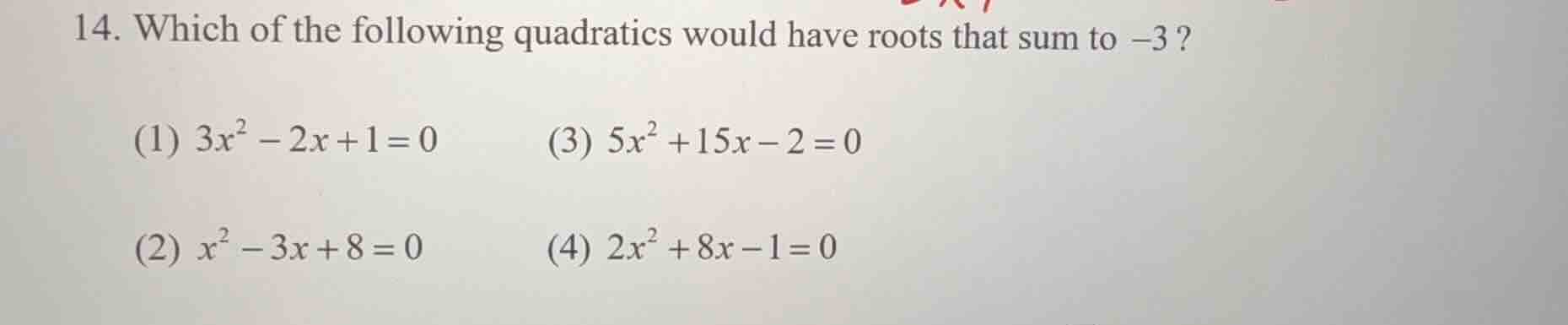
- which of the following quadratics would have roots that sum to -3?
(1) $3x^2 - 2x + 1 = 0$ (3) $5x^2 + 15x - 2 = 0$
(2) $x^2 - 3x + 8 = 0$ (4) $2x^2 + 8x - 1 = 0$
To determine which quadratic equation has roots that sum to \(-3\), we use Vieta's formulas for a quadratic equation of the form \(ax^{2}+bx + c = 0\) (where \(a
eq0\)). The sum of the roots \(r_1\) and \(r_2\) is given by \(r_1 + r_2=-\frac{b}{a}\).
Step 1: Recall Vieta's formula for sum of roots
For a quadratic equation \(ax^{2}+bx + c = 0\) (\(a
eq0\)), the sum of the roots is \(-\frac{b}{a}\). We will apply this formula to each of the given quadratic equations.
Step 2: Analyze equation (1): \(3x^{2}-2x + 1=0\)
Here, \(a = 3\) and \(b=- 2\). The sum of the roots is \(-\frac{b}{a}=-\frac{-2}{3}=\frac{2}{3}
eq - 3\).
Step 3: Analyze equation (2): \(x^{2}-3x + 8=0\)
Here, \(a = 1\) and \(b=-3\). The sum of the roots is \(-\frac{b}{a}=-\frac{-3}{1}=3
eq - 3\).
Step 4: Analyze equation (3): \(5x^{2}+15x - 2=0\)
Here, \(a = 5\) and \(b = 15\). The sum of the roots is \(-\frac{b}{a}=-\frac{15}{5}=-3\).
Step 5: Analyze equation (4): \(2x^{2}+8x - 1=0\)
Here, \(a = 2\) and \(b = 8\). The sum of the roots is \(-\frac{b}{a}=-\frac{8}{2}=-4
eq - 3\).

Snap & solve any problem in the app
Get step-by-step solutions on Sovi AI
Photo-based solutions with guided steps
Explore more problems and detailed explanations
The quadratic equation \(5x^{2}+15x - 2 = 0\) (option (3)) has roots that sum to \(-3\). So the answer is (3) \(5x^{2}+15x - 2=0\)