QUESTION IMAGE
Question
14
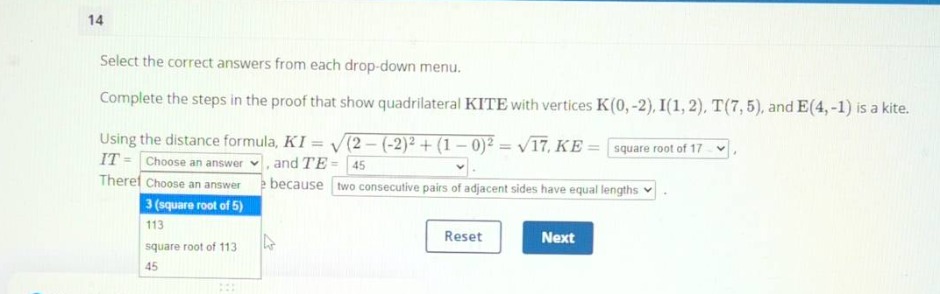
select the correct answers from each drop-down menu.
complete the steps in the proof that show quadrilateral \\(kite\\) with vertices \\(k(0,-2)\\), \\(i(1,2)\\), \\(t(7,5)\\), and \\(e(4,-1)\\) is a kite.
using the distance formula, \\(ki = \sqrt{(2 - (-2))^2 + (1 - 0)^2} = \sqrt{17}\\), \\(ke =\\) square root of 17,
\\(it =\\) choose an answer, and \\(te =\\) 45.
therefore, choose an answer because two consecutive pairs of adjacent sides have equal lengths.
⚡ Using what you learned: transformations in the coordinate plane
Step 1: Calculate KE
Using the distance formula \( d = \sqrt{(x_2 - x_1)^2 + (y_2 - y_1)^2} \) for \( K(0,-2) \) and \( E(4,-1) \):
So, \( KE = \text{square root of 17} \).
Step 2: Calculate IT
Using the distance formula for \( I(1,2) \) and \( T(7,5) \):
Simplifying the radical:
So, \( IT = \text{3 (square root of 5)} \).
Step 3: Calculate TE
Using the distance formula for \( T(7,5) \) and \( E(4,-1) \):
Simplifying the radical:
So, \( TE = \text{3 (square root of 5)} \) (or \( \sqrt{45} \) depending on the dropdown option).
Step 4: Complete the proof statement
Since \( KI = KE = \sqrt{17} \) and \( IT = TE = 3\sqrt{5} \), quadrilateral \( KITE \) is a kite because two consecutive pairs of adjacent sides have equal lengths.

Snap & solve any problem in the app
Get step-by-step solutions on Sovi AI
Photo-based solutions with guided steps
Explore more problems and detailed explanations
- \( KE \):
square root of 17 - \( IT \):
3 (square root of 5) - \( TE \):
3 (square root of 5)(or45under the square root, which simplifies to3 (square root of 5)) - Therefore, \( KITE \) is a kite because:
two consecutive pairs of adjacent sides have equal lengths