QUESTION IMAGE
Question
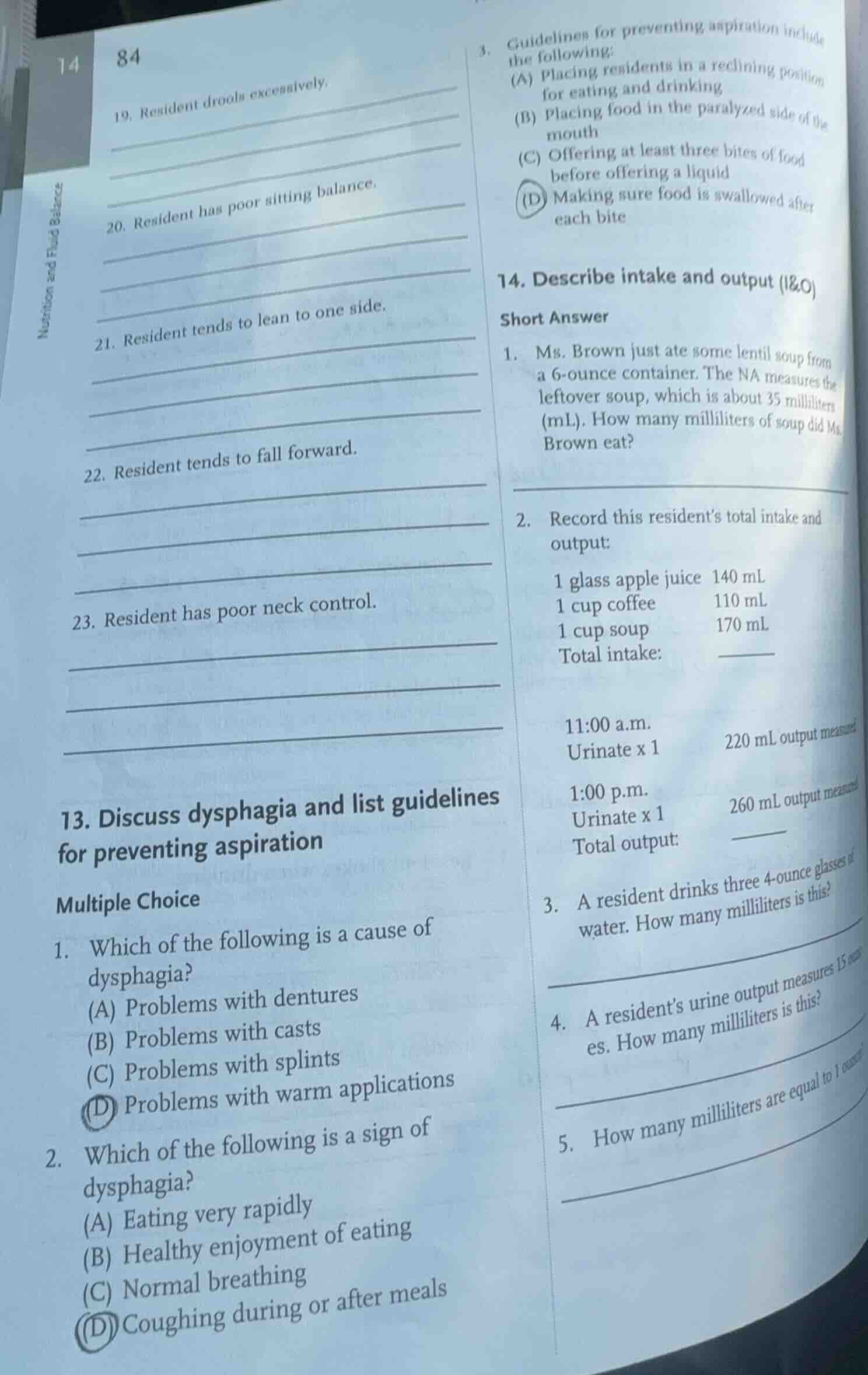
- describe intake and output (i&o)
short answer
- ms. brown just ate some lentil soup from a 6-ounce container. the na measures the leftover soup, which is about 35 milliliters (ml). how many milliliters of soup did ms. brown eat?
- record this residents total intake and output:
1 glass apple juice: 140 ml
1 cup coffee: 110 ml
1 cup soup: 170 ml
total intake: ______
11:00 a.m. urinate x 1: 220 ml output measured
1:00 p.m. urinate x 1: 260 ml output measured
total output: ______
- a resident drinks three 4-ounce glasses of water. how many milliliters is this?
- a residents urine output measures 15 ounces. how many milliliters is this?
- how many milliliters are equal to 1 ounce?
Identify causes and signs of dysphagia
We analyze the multiple-choice questions under section 13: "Discuss dysphagia and list guidelines for preventing aspiration".
- Question 1: "Which of the following is a cause of dysphagia?"
Dysphagia is difficulty swallowing. It is often caused by neurological issues, stroke, or physical issues in the mouth/throat. Among the choices:
(A) Problems with dentures can make chewing and swallowing difficult, contributing to dysphagia.
(B), (C), and (D) (casts, splints, warm applications) do not affect swallowing.
Note: Although the image has a circle around (D) "Problems with warm applications", this is medically incorrect. The correct physiological cause of dysphagia among these options is (A) Problems with dentures.
- Question 2: "Which of the following is a sign of dysphagia?"
Signs of swallowing difficulty include coughing or choking during or after meals, throat clearing, or pocketing food.
Therefore, the correct option is (D) Coughing during or after meals.
- Question 3: "Guidelines for preventing aspiration include the following:"
To prevent aspiration (food/fluid entering the airway), residents should sit upright (90 degrees), food should be placed on the stronger (non-paralyzed) side of the mouth, and we must ensure they swallow each bite before offering more.
Therefore, the correct option is (D) Making sure food is swallowed after each bite.
Calculate Ms. Brown's soup intake
We solve Short Answer Question 1 under section 14: "Describe intake and output (I&O)".
- Ms. Brown had a 6-ounce container of lentil soup.
- We convert ounces to milliliters using the standard medical conversion:
- Total initial volume:
- Leftover soup measured by the Nursing Assistant (NA) is \(35\text{ mL}\).
- Amount eaten:
Calculate total intake and output
We solve Short Answer Question 2:
- Total Intake:
- Apple juice: \(140\text{ mL}\)
- Coffee: \(110\text{ mL}\)
- Soup: \(170\text{ mL}\)
- Total Output:
- 11:00 a.m. Urination: \(220\text{ mL}\)
- 1:00 p.m. Urination: \(260\text{ mL}\)
Calculate fluid conversions for questions 3, 4, and 5
We solve the remaining conversion questions:
- Question 3: "A resident drinks three 4-ounce glasses of water. How many milliliters is this?"
- Total ounces:
- Convert to mL:
- Question 4: "A resident's urine output measures 15 ounces. How many milliliters is this?"
- Convert to mL:
- Question 5: "How many milliliters are equal to 1 ounce?"
- Standard conversion factor:

Snap & solve any problem in the app
Get step-by-step solutions on Sovi AI
Photo-based solutions with guided steps
Explore more problems and detailed explanations
Section 13: Discuss dysphagia and list guidelines for preventing aspiration
Multiple Choice
- Which of the following is a cause of dysphagia?
(A) Problems with dentures
- Which of the following is a sign of dysphagia?
(D) Coughing during or after meals
- Guidelines for preventing aspiration include the following:
(D) Making sure food is swallowed after each bite
---
Section 14: Describe intake and output (I&O)
Short Answer
- How many milliliters of soup did Ms. Brown eat?
\(145\text{ mL}\)
- Record this resident's total intake and output:
- Total intake: \(420\text{ mL}\)
- Total output: \(480\text{ mL}\)
- A resident drinks three 4-ounce glasses of water. How many milliliters is this?
\(360\text{ mL}\)
- A resident's urine output measures 15 ounces. How many milliliters is this?
\(450\text{ mL}\)
- How many milliliters are equal to 1 ounce?
\(30\text{ mL}\)