Sovi.AI - AI Math Tutor

Scan to solve math questions

QUESTION IMAGE

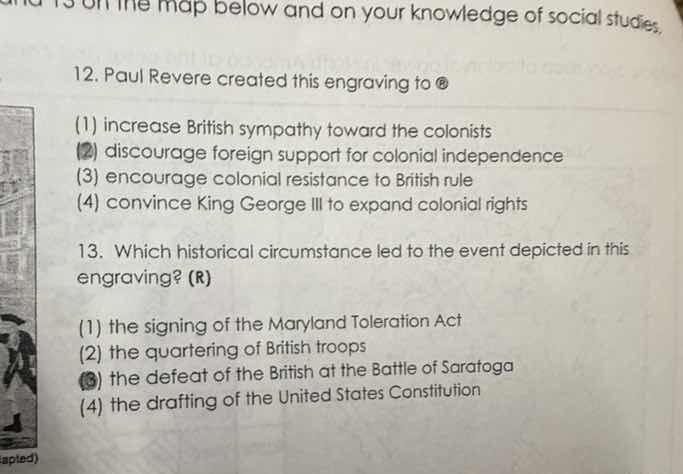
12. paul revere created this engraving to (1) increase british sympathy…

Question

  1. paul revere created this engraving to

(1) increase british sympathy toward the colonists
(2) discourage foreign support for colonial independence
(3) encourage colonial resistance to british rule
(4) convince king george iii to expand colonial rights

  1. which historical circumstance led to the event depicted in this engraving?

(1) the signing of the maryland toleration act
(2) the quartering of british troops
(3) the defeat of the british at the battle of saratoga
(4) the drafting of the united states constitution

Explanation:

Response

<pre_analysis>
{
"quality": "clear",
"question_count": 2,
"skills_matched": [
"direct_cot",
"multiple_choice_formatter",
"explain_then_answer",
"tutor"
],
"needs_drawing": false,
"concepts_used": [
"Revolutionary Propaganda",
"Stamp Act"
],
"new_concepts": [
"Boston Massacre",
"Quartering Act"
],
"current_concepts": [
"Revolutionary Propaganda",
"Boston Massacre",
"Quartering Act",
"British Colonial Taxation"
]
}
</pre_analysis>

<reasoning>

Identify the engraving and its purpose

The questions refer to a famous engraving by Paul Revere depicting the Boston Massacre (1770). Revere, a prominent Patriot, produced this highly sensationalized image as Revolutionary Propaganda to shape public opinion. By depicting organized British soldiers firing on peaceful, unarmed colonists, the engraving aimed to fuel anti-British sentiment and encourage colonial resistance to British rule. Therefore, for Question 12, option (3) is the correct purpose.

Analyze the historical circumstances

The Boston Massacre occurred on March 5, 1770, amid rising tensions in Boston. A key source of this friction was the presence of British military forces sent to enforce unpopular taxes like the Stamp Act and Townshend Acts. Under the Quartering Act, colonists were forced to house and feed these soldiers. The constant, daily friction caused by the quartering of British troops in a civilian city directly led to the physical confrontations that culminated in the Boston Massacre. Therefore, for Question 13, option (2) is the correct historical circumstance.
</reasoning>

<answer>

Question 12

<mcq-option>(1) increase British sympathy toward the colonists</mcq-option>
<mcq-option>(2) discourage foreign support for colonial independence</mcq-option>
<mcq-correct>(3) encourage colonial resistance to British rule</mcq-correct>
<mcq-option>(4) convince King George III to expand colonial rights</mcq-option>

Question 13

<mcq-option>(1) the signing of the Maryland Toleration Act</mcq-option>
<mcq-correct>(2) the quartering of British troops</mcq-correct>
<mcq-option>(3) the defeat of the British at the Battle of Saratoga</mcq-option>
<mcq-option>(4) the drafting of the United States Constitution</mcq-option>
</answer>

<post_analysis>
{
"subject": "Social Science",
"question_type": "Multiple Choice",
"knowledge_point": [
"Social Science",
"US History",
"American Revolution"
]
}
</post_analysis>

Answer:

<pre_analysis>
{
"quality": "clear",
"question_count": 2,
"skills_matched": [
"direct_cot",
"multiple_choice_formatter",
"explain_then_answer",
"tutor"
],
"needs_drawing": false,
"concepts_used": [
"Revolutionary Propaganda",
"Stamp Act"
],
"new_concepts": [
"Boston Massacre",
"Quartering Act"
],
"current_concepts": [
"Revolutionary Propaganda",
"Boston Massacre",
"Quartering Act",
"British Colonial Taxation"
]
}
</pre_analysis>

<reasoning>

Identify the engraving and its purpose

The questions refer to a famous engraving by Paul Revere depicting the Boston Massacre (1770). Revere, a prominent Patriot, produced this highly sensationalized image as Revolutionary Propaganda to shape public opinion. By depicting organized British soldiers firing on peaceful, unarmed colonists, the engraving aimed to fuel anti-British sentiment and encourage colonial resistance to British rule. Therefore, for Question 12, option (3) is the correct purpose.

Analyze the historical circumstances

The Boston Massacre occurred on March 5, 1770, amid rising tensions in Boston. A key source of this friction was the presence of British military forces sent to enforce unpopular taxes like the Stamp Act and Townshend Acts. Under the Quartering Act, colonists were forced to house and feed these soldiers. The constant, daily friction caused by the quartering of British troops in a civilian city directly led to the physical confrontations that culminated in the Boston Massacre. Therefore, for Question 13, option (2) is the correct historical circumstance.
</reasoning>

<answer>

Question 12

<mcq-option>(1) increase British sympathy toward the colonists</mcq-option>
<mcq-option>(2) discourage foreign support for colonial independence</mcq-option>
<mcq-correct>(3) encourage colonial resistance to British rule</mcq-correct>
<mcq-option>(4) convince King George III to expand colonial rights</mcq-option>

Question 13

<mcq-option>(1) the signing of the Maryland Toleration Act</mcq-option>
<mcq-correct>(2) the quartering of British troops</mcq-correct>
<mcq-option>(3) the defeat of the British at the Battle of Saratoga</mcq-option>
<mcq-option>(4) the drafting of the United States Constitution</mcq-option>
</answer>

<post_analysis>
{
"subject": "Social Science",
"question_type": "Multiple Choice",
"knowledge_point": [
"Social Science",
"US History",
"American Revolution"
]
}
</post_analysis>