QUESTION IMAGE
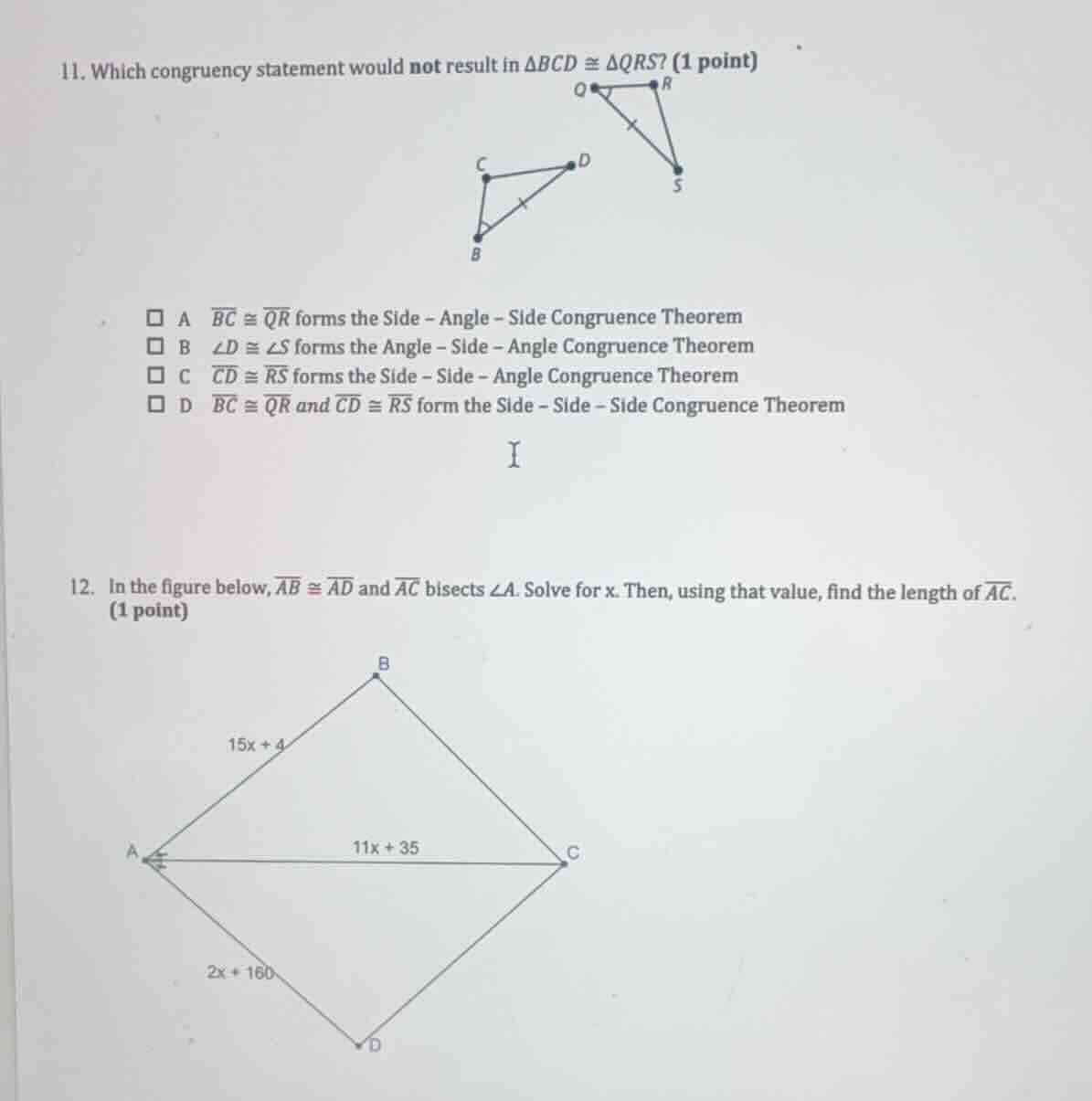
Question
- which congruency statement would not result in \\(\delta bcd \cong \delta qrs\\)? (1 point)
a \\(\overline{bc} \cong \overline{qr}\\) forms the side-angle-side congruence theorem
b \\(\angle d \cong \angle s\\) forms the angle-side-angle congruence theorem
c \\(\overline{cd} \cong \overline{rs}\\) forms the side-side-angle congruence theorem
d \\(\overline{bc} \cong \overline{qr}\\) and \\(\overline{cd} \cong \overline{rs}\\) form the side-side-side congruence theorem
- in the figure below, \\(\overline{ab} \cong \overline{ad}\\) and \\(\overline{ac}\\) bisects \\(\angle a\\). solve for x. then, using that value, find the length of \\(\overline{ac}\\). (1 point)
Analyze given information for Question 11
Using the Triangle Congruence Postulates knowledge point
- We are given two triangles, \(\Delta BCD\) and \(\Delta QRS\), with marked congruent parts: angle \(\angle B \cong \angle Q\) and side \(BD \cong QS\).
- We need to find which statement does not prove \(\Delta BCD \cong \Delta QRS\).
- Option C suggests \(\overline{CD} \cong \overline{RS}\), which gives two sides and a non-included angle (SSA). SSA is not a valid congruence postulate.
Analyze given information for Question 12
Using the SAS Congruence Application and Solving Linear Equations knowledge points
- Given: \(\overline{AB} \cong \overline{AD}\), which means \(AB = AD\).
- From the figure, \(AB = 15x + 4\) and \(AD = 2x + 160\).
- Since \(\overline{AB} \cong \overline{AD}\), we set up the equation:
$$15x + 4 = 2x + 160$$
- Solve for \(x\):
$$13x = 156 \implies x = 12$$
Calculate the length of AC
Using the Solving Linear Equations knowledge point
- The length of \(\overline{AC}\) is given by the expression \(11x + 35\).
- Substitute \(x = 12\) into the expression:
$$AC = 11(12) + 35 = 132 + 35 = 167$$

Snap & solve any problem in the app
Get step-by-step solutions on Sovi AI
Photo-based solutions with guided steps
Explore more problems and detailed explanations
Question 11
- A \(\overline{BC} \cong \overline{QR}\) forms the Side-Angle-Side Congruence Theorem
- B \(\angle D \cong \angle S\) forms the Angle-Side-Angle Congruence Theorem
- C \(\overline{CD} \cong \overline{RS}\) forms the Side-Side-Angle Congruence Theorem (Correct answer)
- D \(\overline{BC} \cong \overline{QR}\) and \(\overline{CD} \cong \overline{RS}\) form the Side-Side-Side Congruence Theorem
Question 12
\(x = 12\), \(AC = 167\)