QUESTION IMAGE
Question
10
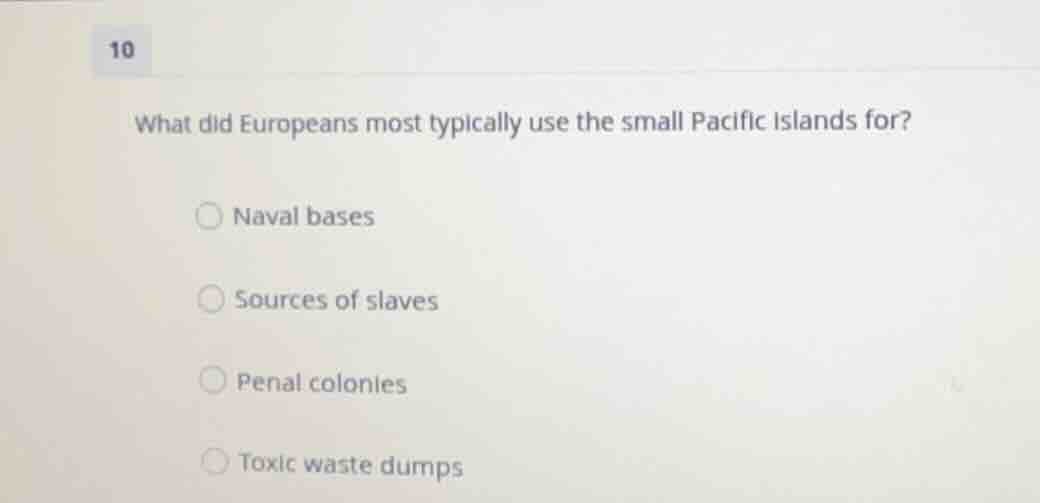
what did europeans most typically use the small pacific islands for?
naval bases
sources of slaves
penal colonies
toxic waste dumps
<pre_analysis>
{
"quality": "clear",
"question_count": 1,
"skills_matched": [
"direct_cot",
"multiple_choice_formatter",
"explain_then_answer",
"quick"
],
"needs_drawing": false,
"concepts_used": [
"Oceanian Geopolitics"
],
"new_concepts": [
"Pacific Imperialism",
"Coaling Stations"
],
"current_concepts": [
"Oceanian Geopolitics",
"Pacific Imperialism",
"Coaling Stations"
]
}
</pre_analysis>
<reasoning>
Analyze the historical role of small Pacific Islands
During the era of imperialism and global expansion, European powers and later the United States valued small, isolated Pacific islands primarily for strategic military and maritime purposes, establishing refueling stations (coaling stations) and naval bases to secure trade routes.
Evaluate the given options
- Naval bases: Small islands served as critical strategic outposts, refueling stations, and military bases to control maritime routes.
- Sources of slaves: While labor exploitation (like blackbirding) occurred, these small islands were not primarily used as major sources of slaves compared to other regions.
- Penal colonies: Only specific, larger territories (like Australia or New Caledonia) were used as penal colonies, not small Pacific islands typically.
- Toxic waste dumps: This is not a historical colonial-era use of these islands.
</reasoning>
<answer>
<mcq-correct>Naval bases</mcq-correct>
<mcq-option>Sources of slaves</mcq-option>
<mcq-option>Penal colonies</mcq-option>
<mcq-option>Toxic waste dumps</mcq-option>
</answer>
<post_analysis>
{
"subject": "Social Science",
"question_type": "Multiple Choice",
"knowledge_point": [
"Social Science",
"Geography",
"Oceanian Geopolitics"
]
}
</post_analysis>
Snap & solve any problem in the app
Get step-by-step solutions on Sovi AI
Photo-based solutions with guided steps
Explore more problems and detailed explanations
<pre_analysis>
{
"quality": "clear",
"question_count": 1,
"skills_matched": [
"direct_cot",
"multiple_choice_formatter",
"explain_then_answer",
"quick"
],
"needs_drawing": false,
"concepts_used": [
"Oceanian Geopolitics"
],
"new_concepts": [
"Pacific Imperialism",
"Coaling Stations"
],
"current_concepts": [
"Oceanian Geopolitics",
"Pacific Imperialism",
"Coaling Stations"
]
}
</pre_analysis>
<reasoning>
Analyze the historical role of small Pacific Islands
During the era of imperialism and global expansion, European powers and later the United States valued small, isolated Pacific islands primarily for strategic military and maritime purposes, establishing refueling stations (coaling stations) and naval bases to secure trade routes.
Evaluate the given options
- Naval bases: Small islands served as critical strategic outposts, refueling stations, and military bases to control maritime routes.
- Sources of slaves: While labor exploitation (like blackbirding) occurred, these small islands were not primarily used as major sources of slaves compared to other regions.
- Penal colonies: Only specific, larger territories (like Australia or New Caledonia) were used as penal colonies, not small Pacific islands typically.
- Toxic waste dumps: This is not a historical colonial-era use of these islands.
</reasoning>
<answer>
<mcq-correct>Naval bases</mcq-correct>
<mcq-option>Sources of slaves</mcq-option>
<mcq-option>Penal colonies</mcq-option>
<mcq-option>Toxic waste dumps</mcq-option>
</answer>
<post_analysis>
{
"subject": "Social Science",
"question_type": "Multiple Choice",
"knowledge_point": [
"Social Science",
"Geography",
"Oceanian Geopolitics"
]
}
</post_analysis>