QUESTION IMAGE
Question
(03.03 hc)
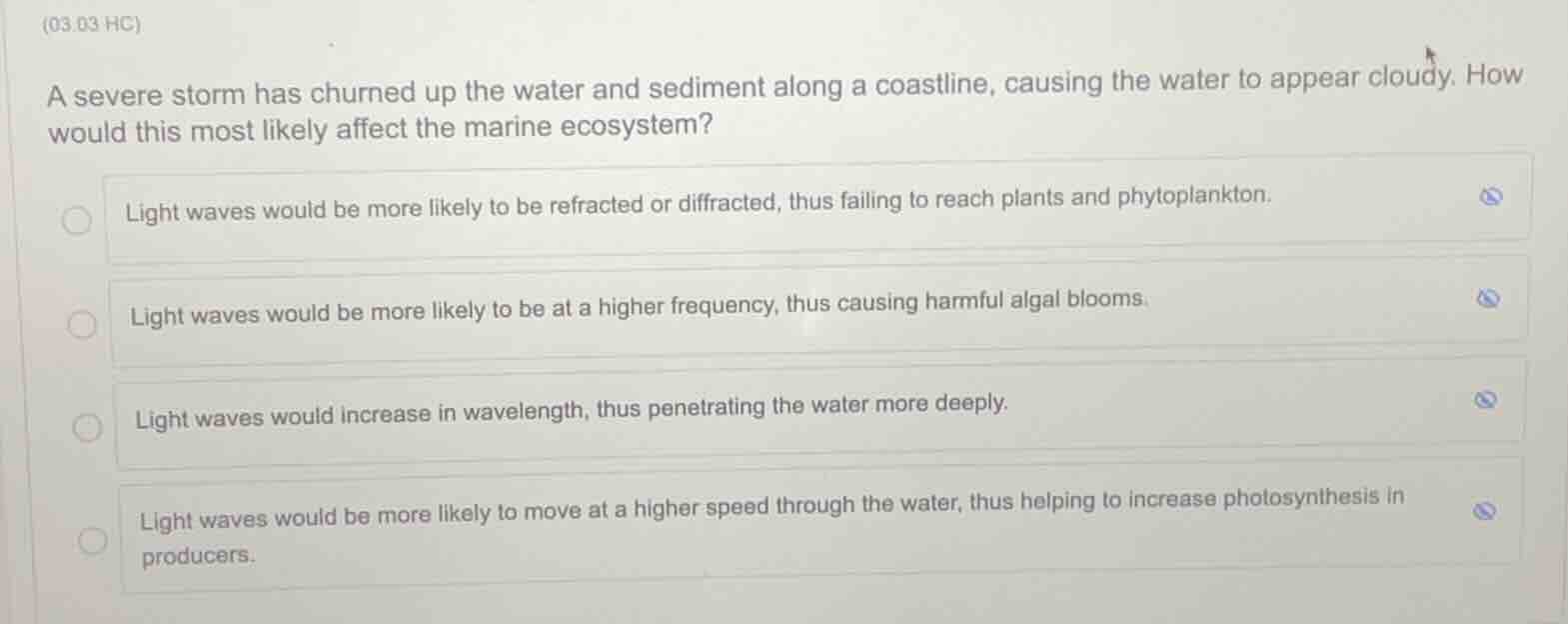
a severe storm has churned up the water and sediment along a coastline, causing the water to appear cloudy. how would this most likely affect the marine ecosystem?
- light waves would be more likely to be refracted or diffracted, thus failing to reach plants and phytoplankton.
- light waves would be more likely to be at a higher frequency, thus causing harmful algal blooms.
- light waves would increase in wavelength, thus penetrating the water more deeply.
- light waves would be more likely to move at a higher speed through the water, thus helping to increase photosynthesis in producers.
Analyze the environmental change
A severe storm churns up water and sediment, making the water cloudy (increasing turbidity). Suspended sediment particles block, scatter, refract, and diffract incoming sunlight.
Evaluate light behavior in turbid water
As light enters cloudy water, it hits suspended particles. This causes the light waves to scatter, refract, or diffract, preventing them from penetrating deeply into the water column.
Determine the ecological impact
Because light is scattered and blocked, less light reaches primary producers like aquatic plants and phytoplankton. This reduction in light limits their ability to perform photosynthesis, disrupting the base of the marine food web.
Assess the given options
- Option 1 correctly states that light waves are more likely to be refracted or diffracted, failing to reach plants and phytoplankton.
- Option 2 is incorrect because turbidity does not change the frequency of incoming light waves to cause algal blooms.
- Option 3 is incorrect because turbidity does not increase the wavelength of light to allow deeper penetration.
- Option 4 is incorrect because light does not travel faster through cloudy water, nor does it increase photosynthesis.

Snap & solve any problem in the app
Get step-by-step solutions on Sovi AI
Photo-based solutions with guided steps
Explore more problems and detailed explanations
- (A) Light waves would be more likely to be refracted or diffracted, thus failing to reach plants and phytoplankton. (Correct answer)
- (B) Light waves would be more likely to be at a higher frequency, thus causing harmful algal blooms.
- (C) Light waves would increase in wavelength, thus penetrating the water more deeply.
- (D) Light waves would be more likely to move at a higher speed through the water, thus helping to increase photosynthesis in producers.