QUESTION IMAGE
Question
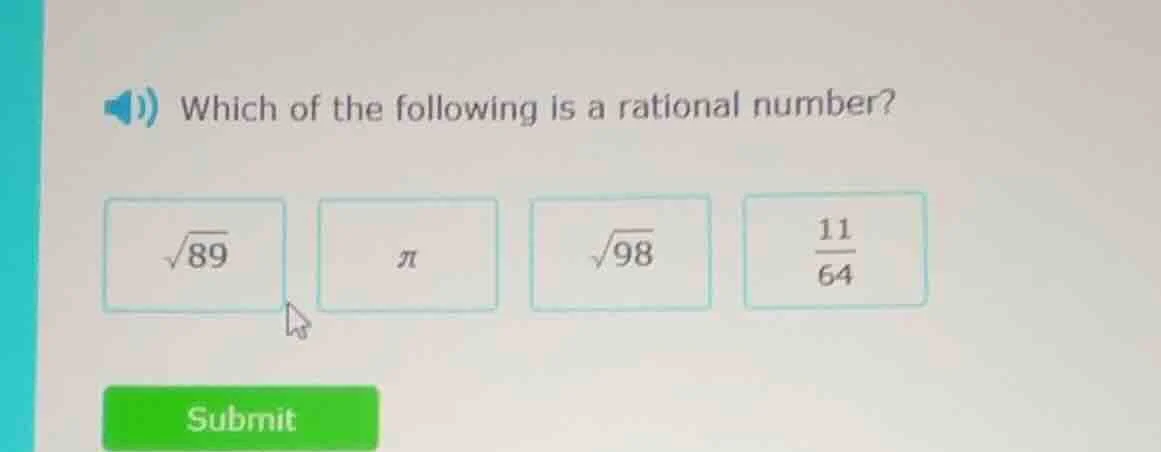
which of the following is a rational number?
$sqrt{89}$ $pi$ $sqrt{98}$ $\frac{11}{64}$
submit
Step1: Recall rational number definition
A rational number is a number that can be expressed as $\frac{p}{q}$, where $p$ and $q$ are integers and $q
eq0$. It can be a fraction, integer, terminating or repeating decimal. Irrational numbers are non - repeating, non - terminating decimals, often from square roots of non - perfect squares or special constants like $\pi$.
Step2: Analyze $\sqrt{89}$
89 is a prime number, so $\sqrt{89}$ is a square root of a non - perfect square. By the definition of irrational numbers, $\sqrt{89}$ is irrational because it cannot be expressed as a fraction of two integers and its decimal expansion is non - repeating and non - terminating.
Step3: Analyze $\pi$
$\pi = 3.1415926535\cdots$ is a well - known irrational number with a non - repeating, non - terminating decimal expansion.
Step4: Analyze $\sqrt{98}$
Simplify $\sqrt{98}=\sqrt{49\times2} = 7\sqrt{2}$. Since $\sqrt{2}$ is irrational, $7\sqrt{2}$ (and thus $\sqrt{98}$) is also irrational because the product of a non - zero rational number and an irrational number is irrational.
Step5: Analyze $\frac{11}{64}$
$\frac{11}{64}$ is in the form of $\frac{p}{q}$ where $p = 11$ and $q = 64$ are integers and $q
eq0$. So, by the definition of a rational number, $\frac{11}{64}$ is a rational number.

Snap & solve any problem in the app
Get step-by-step solutions on Sovi AI
Photo-based solutions with guided steps
Explore more problems and detailed explanations
$\frac{11}{64}$ (the option with $\frac{11}{64}$)