QUESTION IMAGE
Question
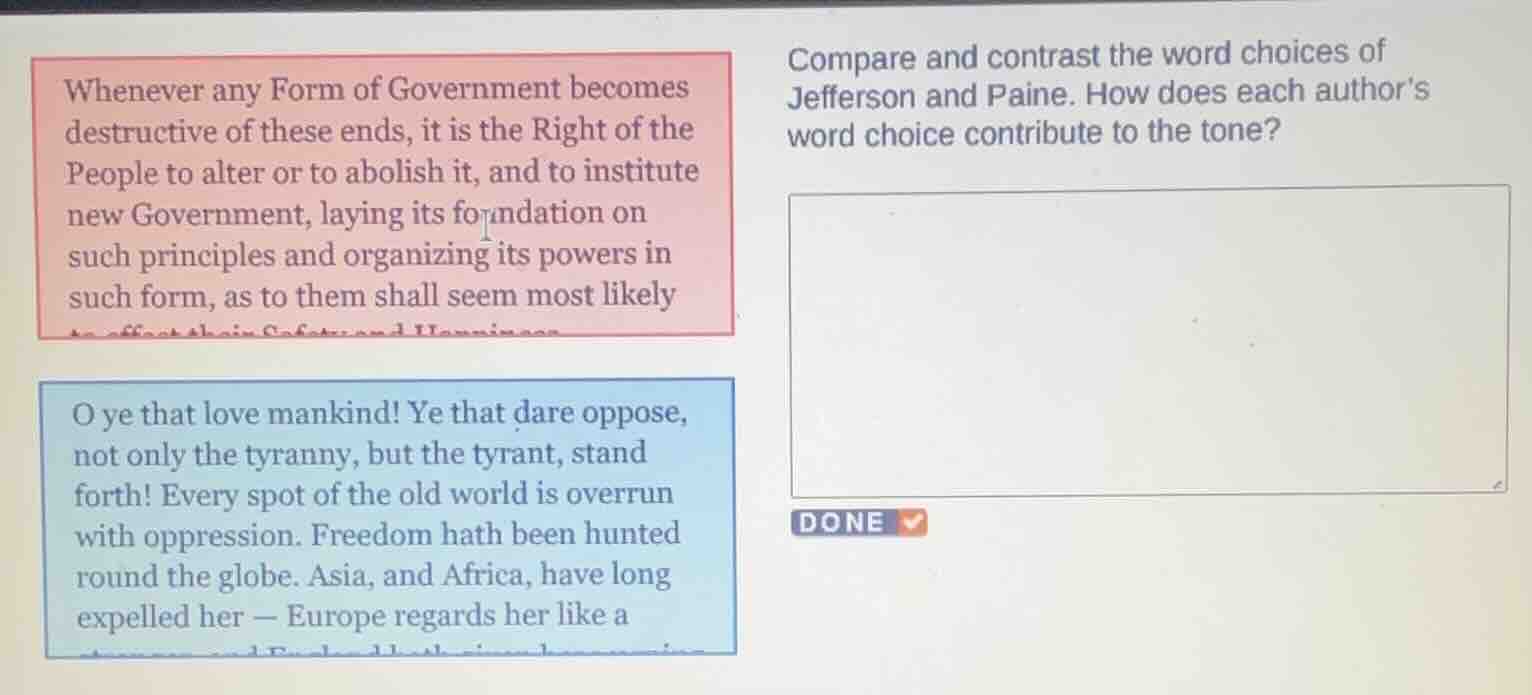
whenever any form of government becomes destructive of these ends, it is the right of the people to alter or to abolish it, and to institute new government, laying its foundation on such principles and organizing its powers in such form, as to them shall seem most likely
o ye that love mankind! ye that dare oppose, not only the tyranny, but the tyrant, stand forth! every spot of the old world is overrun with oppression. freedom hath been hunted round the globe. asia, and africa, have long expelled her — europe regards her like a
compare and contrast the word choices of jefferson and paine. how does each author’s word choice contribute to the tone?
- Jefferson's Word Choice & Tone: Uses formal, legal, impersonal language (e.g., "Form of Government," "Right of the People," "principles") that frames the right to alter government as a logical, legitimate, and universal civic principle. This creates a calm, authoritative, and serious tone, positioning the argument as a reasoned, official declaration rather than a passionate appeal.
- Paine's Word Choice & Tone: Uses emotional, urgent, and direct language (e.g., "O ye that love mankind!," "dare oppose," "tyrant," "hunted"). He employs rhetorical address, vivid imagery, and dramatic phrasing to rally readers. This creates a fiery, impassioned, and call-to-action tone, framing the fight for freedom as a moral, urgent struggle.
- Contrast: Jefferson prioritizes legal formality and rational legitimacy, while Paine prioritizes emotional appeal and direct incitement; Jefferson's tone is institutional, Paine's is populist and urgent.

Snap & solve any problem in the app
Get step-by-step solutions on Sovi AI
Photo-based solutions with guided steps
Explore more problems and detailed explanations
- Jefferson: Uses formal, legal, impersonal vocabulary (e.g., "Right of the People," "principles") to create an authoritative, serious, reasoned tone, framing the right to change government as a legitimate, universal civic principle.
- Paine: Uses emotional, direct, dramatic language (e.g., "O ye that love mankind!," "tyrant," "hunted") to create a fiery, urgent, impassioned tone, rallying readers to an urgent moral struggle against oppression.
- Key Contrast: Jefferson's word choice emphasizes legal legitimacy and calm logic, while Paine's emphasizes emotional incitement and populist urgency.