QUESTION IMAGE
Question
read the excerpt from act 3 of a dolls house.
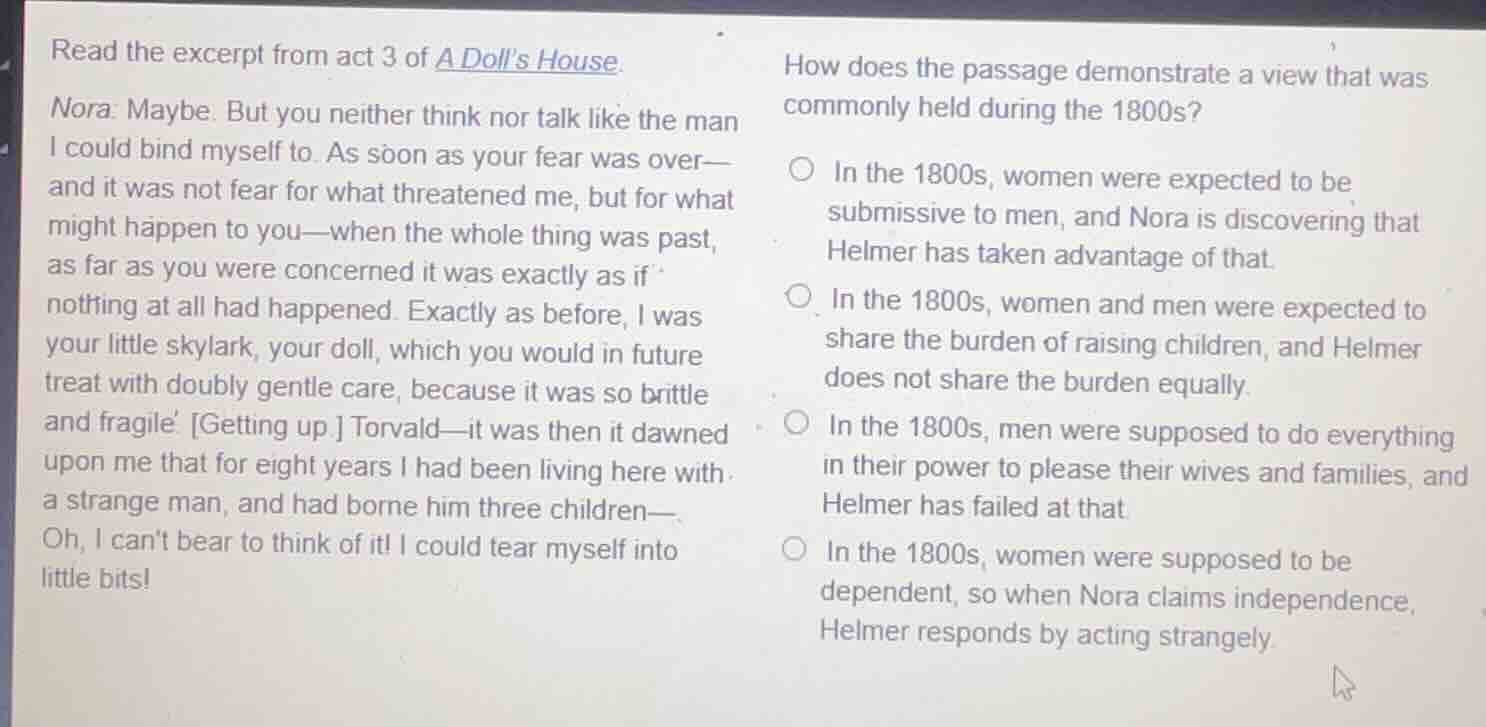
nora: maybe. but you neither think nor talk like the man i could bind myself to. as soon as your fear was over—and it was not fear for what threatened me, but for what might happen to you—when the whole thing was past, as far as you were concerned it was exactly as if nothing at all had happened. exactly as before, i was your little skylark, your doll, which you would in future treat with doubly gentle care, because it was so brittle and fragile. getting up. torvald—it was then it dawned upon me that for eight years i had been living here with a strange man, and had borne him three children— oh, i cant bear to think of it! i could tear myself into little bits!
how does the passage demonstrate a view that was commonly held during the 1800s?
○ in the 1800s, women were expected to be submissive to men, and nora is discovering that helmer has taken advantage of that.
○ in the 1800s, women and men were expected to share the burden of raising children, and helmer does not share the burden equally.
○ in the 1800s, men were supposed to do everything in their power to please their wives and families, and helmer has failed at that.
○ in the 1800s, women were supposed to be dependent, so when nora claims independence, helmer responds by acting strangely.
The excerpt shows Nora realizing Helmer treated her as a "little skylark" and "doll"—a passive, submissive figure. This reflects the 1800s norm that women were expected to be submissive to men, and Nora is recognizing how Helmer exploited this dynamic. The other options are incorrect: the passage does not focus on child-rearing burdens, men pleasing families, or Helmer acting strange over Nora's independence claims.

Snap & solve any problem in the app
Get step-by-step solutions on Sovi AI
Photo-based solutions with guided steps
Explore more problems and detailed explanations
In the 1800s, women were expected to be submissive to men, and Nora is discovering that Helmer has taken advantage of that.