QUESTION IMAGE
Question
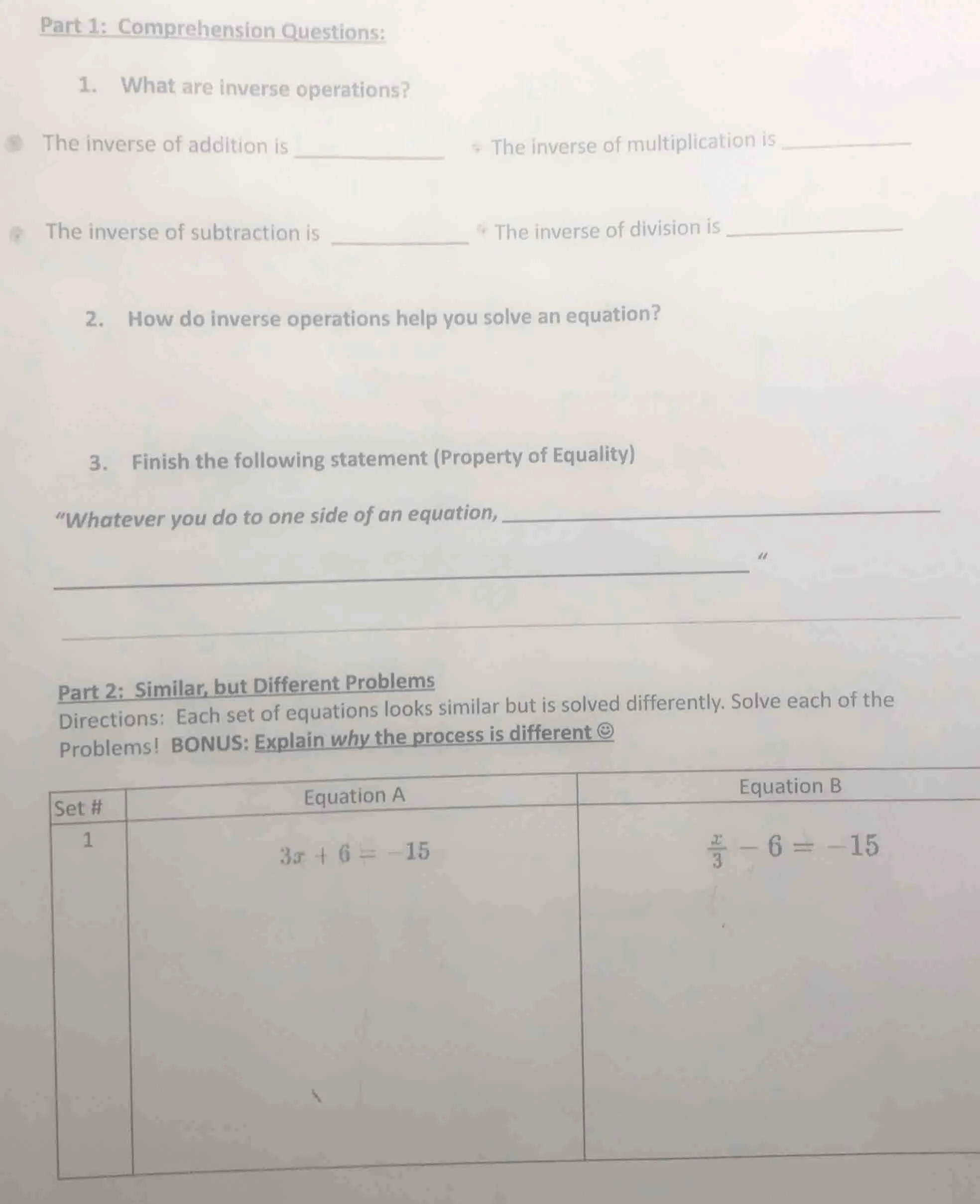
part 1: comprehension questions:
- what are inverse operations?
the inverse of addition is ____ the inverse of multiplication is ____
the inverse of subtraction is ____ the inverse of division is ____
- how do inverse operations help you solve an equation?
- finish the following statement (property of equality)
\whatever you do to one side of an equation, ______
______\
part 2: similar, but different problems
directions: each set of equations looks similar but is solved differently. solve each of the problems! bonus: explain why the process is different
| set # | equation a | equation b |
|---|
Part 1: Comprehension Questions
1. What are inverse operations?
Inverse operations are operations that "undo" each other.
- The inverse of addition is subtraction.
- The inverse of multiplication is division.
- The inverse of subtraction is addition.
- The inverse of division is multiplication.
2. How do inverse operations help you solve an equation?
Inverse operations help isolate the variable in an equation. For example, if a variable is added to a number, we use subtraction (the inverse of addition) to get the variable alone, and if a variable is multiplied by a number, we use division (the inverse of multiplication) to isolate it. This follows the property of equality to keep the equation balanced.
3. Finish the following statement (Property of Equality)
"Whatever you do to one side of an equation, you must do to the other side to keep the equation balanced."
Part 2: Similar, but Different Problems
Set #1: Solve Equation A and Equation B
Equation A: \( 3x + 6 = -15 \)
Step 1: Subtract 6 from both sides
To isolate the term with \( x \), we use the inverse of addition (subtraction). Subtract 6 from both sides:
\( 3x + 6 - 6 = -15 - 6 \)
Simplify: \( 3x = -21 \)
Step 2: Divide by 3
Now, use the inverse of multiplication (division) to isolate \( x \). Divide both sides by 3:
\( \frac{3x}{3} = \frac{-21}{3} \)
Simplify: \( x = -7 \)
Equation B: \( \frac{x}{3} - 6 = -15 \)
Step 1: Add 6 to both sides
To isolate the term with \( x \), use the inverse of subtraction (addition). Add 6 to both sides:
\( \frac{x}{3} - 6 + 6 = -15 + 6 \)
Simplify: \( \frac{x}{3} = -9 \)
Step 2: Multiply by 3
Use the inverse of division (multiplication) to isolate \( x \). Multiply both sides by 3:
\( \frac{x}{3} \times 3 = -9 \times 3 \)
Simplify: \( x = -27 \)
BONUS: Explain why the process is different
The processes differ because the operations attached to the variable are different. In Equation A, the variable \( x \) is first multiplied by 3 and then added to 6, so we reverse the order: subtract 6 first (inverse of addition) then divide by 3 (inverse of multiplication). In Equation B, the variable \( x \) is first divided by 3 and then subtracted by 6, so we reverse the order: add 6 first (inverse of subtraction) then multiply by 3 (inverse of division). The order of using inverse operations follows the reverse of the order of operations (PEMDAS/BODMAS) applied to the variable.

Snap & solve any problem in the app
Get step-by-step solutions on Sovi AI
Photo-based solutions with guided steps
Explore more problems and detailed explanations
Step 1: Add 6 to both sides
To isolate the term with \( x \), use the inverse of subtraction (addition). Add 6 to both sides:
\( \frac{x}{3} - 6 + 6 = -15 + 6 \)
Simplify: \( \frac{x}{3} = -9 \)
Step 2: Multiply by 3
Use the inverse of division (multiplication) to isolate \( x \). Multiply both sides by 3:
\( \frac{x}{3} \times 3 = -9 \times 3 \)
Simplify: \( x = -27 \)
BONUS: Explain why the process is different
The processes differ because the operations attached to the variable are different. In Equation A, the variable \( x \) is first multiplied by 3 and then added to 6, so we reverse the order: subtract 6 first (inverse of addition) then divide by 3 (inverse of multiplication). In Equation B, the variable \( x \) is first divided by 3 and then subtracted by 6, so we reverse the order: add 6 first (inverse of subtraction) then multiply by 3 (inverse of division). The order of using inverse operations follows the reverse of the order of operations (PEMDAS/BODMAS) applied to the variable.