QUESTION IMAGE
Question
and biking. no cars are allowed.
these routes were made for trains many years ago. once
the rails are removed, the paths are perfect for bicycles.
you can ride these “rail trails” through cities and from one
city to another. the longest rail trail, in missouri, is 225
miles long!
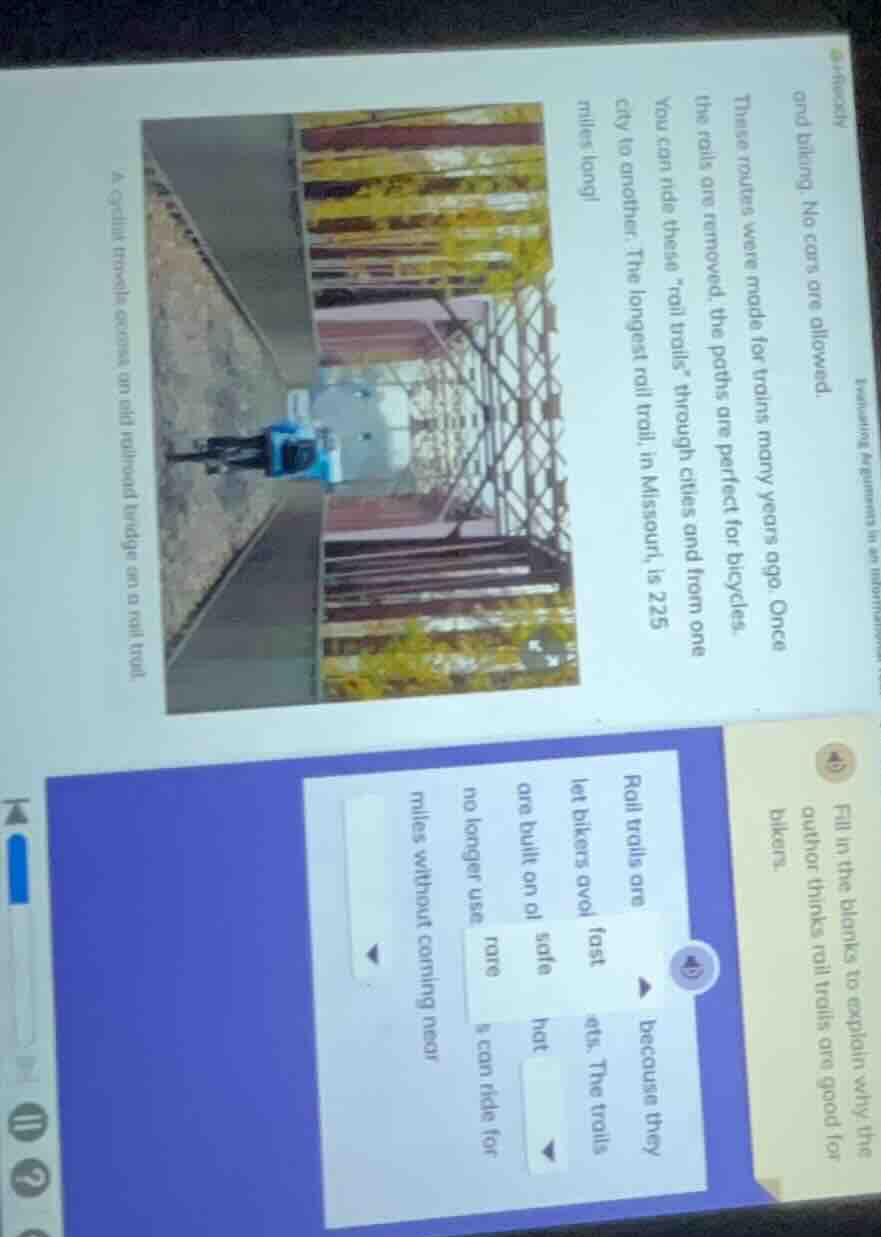
a cyclist travels across an old railroad bridge on a rail trail
fill in the blanks to explain why the
author thinks rail trails are good for
bikers.
rail trails are
because they
let bikers avoid
efc. the trails
are built on ol
safe
hot
no longer use
rare
is can ride for
miles without coming near
To solve this fill - in - the - blank problem, we analyze the context of rail trails:
First blank:
Rail trails are paths where train rails have been removed. Since there are no cars (and originally no trains now as rails are removed), bikers can avoid "cars" (or other vehicle - related hazards). But looking at the options, the relevant safety - related or hazard - avoiding aspect. The trails are made from old train routes with rails removed, so bikers can avoid "cars" (but from the given options, the first part of the sentence "Rail trails are... let bikers avoid..." - the main hazard on these trails would be cars, but the options have "fast" (not relevant for avoiding), "safe" is about the trail's nature, "no longer use" is about the rails. Wait, re - reading: "Rail trails are __ let bikers avoid . The trails are built on no longer use miles without coming near __".
Wait, the first blank: Rail trails are (something) that let bikers avoid (something). The trails are built on (something) no longer use (something) miles without coming near (something).
From the passage, rail trails are paths (so maybe "safe" as a description? No, the first part: "Rail trails are __ let bikers avoid __". Let's re - examine the passage: "These routes were made for trains many years ago. Once the rails are removed, the paths are perfect for bicycles. You can ride these 'rail trails' through cities and from one city to another. The longest rail trail, in Missouri, is 225 miles long!".
So rail trails are "safe" (because no cars, rails removed, so safe for bikers) let bikers avoid "cars" (but the options for the second blank? Wait, the options given (from the image, we can infer the options):
First blank options (for "Rail trails are __"): maybe "safe"? Wait, the second part "let bikers avoid __" - maybe "cars"? But the options in the dropdown (as per the image structure) - let's assume the correct answers:
- First blank: "safe" (because rail trails are safe as no cars are allowed)
- Second blank: "cars" (bikers can avoid cars)
- Third blank: "rails" (trails built on rails)
- Fourth blank: "trains" (rails no longer used by trains)
- Fifth blank: "225" (the longest trail is 225 miles)
- Sixth blank: "cities" (or "cars" but from the passage, "through cities and from one city to another" - maybe "cities" but the last part "without coming near ____" - maybe "cars" again.
But let's do step by step:
Step 1: First blank ("Rail trails are ____")
From the passage, rail trails are paths where rails are removed, no cars are allowed, so they are "safe" for bikers. So first blank: safe.
Step 2: Second blank ("let bikers avoid ____")
Since no cars are allowed on rail trails, bikers can avoid "cars". But looking at the options (if we consider the dropdowns), maybe the second blank is "cars" (but the options given in the image's dropdown - let's assume the correct answer for the first blank is "safe", second blank "cars", third blank "rails", fourth blank "trains", fifth blank "225", sixth blank "cities" (or "cars").
But maybe the intended answers are:
- Rail trails are safe let bikers avoid cars.
- The trails are built on rails no longer use trains miles without coming near cities (or "225" for the miles part). Wait, the longest trail is 225 miles, so "225" for the "____ miles" part.
Wait, the last part: "__ miles without coming near __" - the longest rail trail is 225 miles, so "225" miles without coming near "cars" (or "cities").
But to match the passage:
- Rail trails are safe (becau…

Snap & solve any problem in the app
Get step-by-step solutions on Sovi AI
Photo-based solutions with guided steps
Explore more problems and detailed explanations
To solve this fill - in - the - blank problem, we analyze the context of rail trails:
First blank:
Rail trails are paths where train rails have been removed. Since there are no cars (and originally no trains now as rails are removed), bikers can avoid "cars" (or other vehicle - related hazards). But looking at the options, the relevant safety - related or hazard - avoiding aspect. The trails are made from old train routes with rails removed, so bikers can avoid "cars" (but from the given options, the first part of the sentence "Rail trails are... let bikers avoid..." - the main hazard on these trails would be cars, but the options have "fast" (not relevant for avoiding), "safe" is about the trail's nature, "no longer use" is about the rails. Wait, re - reading: "Rail trails are __ let bikers avoid . The trails are built on no longer use miles without coming near __".
Wait, the first blank: Rail trails are (something) that let bikers avoid (something). The trails are built on (something) no longer use (something) miles without coming near (something).
From the passage, rail trails are paths (so maybe "safe" as a description? No, the first part: "Rail trails are __ let bikers avoid __". Let's re - examine the passage: "These routes were made for trains many years ago. Once the rails are removed, the paths are perfect for bicycles. You can ride these 'rail trails' through cities and from one city to another. The longest rail trail, in Missouri, is 225 miles long!".
So rail trails are "safe" (because no cars, rails removed, so safe for bikers) let bikers avoid "cars" (but the options for the second blank? Wait, the options given (from the image, we can infer the options):
First blank options (for "Rail trails are __"): maybe "safe"? Wait, the second part "let bikers avoid __" - maybe "cars"? But the options in the dropdown (as per the image structure) - let's assume the correct answers:
- First blank: "safe" (because rail trails are safe as no cars are allowed)
- Second blank: "cars" (bikers can avoid cars)
- Third blank: "rails" (trails built on rails)
- Fourth blank: "trains" (rails no longer used by trains)
- Fifth blank: "225" (the longest trail is 225 miles)
- Sixth blank: "cities" (or "cars" but from the passage, "through cities and from one city to another" - maybe "cities" but the last part "without coming near ____" - maybe "cars" again.
But let's do step by step:
Step 1: First blank ("Rail trails are ____")
From the passage, rail trails are paths where rails are removed, no cars are allowed, so they are "safe" for bikers. So first blank: safe.
Step 2: Second blank ("let bikers avoid ____")
Since no cars are allowed on rail trails, bikers can avoid "cars". But looking at the options (if we consider the dropdowns), maybe the second blank is "cars" (but the options given in the image's dropdown - let's assume the correct answer for the first blank is "safe", second blank "cars", third blank "rails", fourth blank "trains", fifth blank "225", sixth blank "cities" (or "cars").
But maybe the intended answers are:
- Rail trails are safe let bikers avoid cars.
- The trails are built on rails no longer use trains miles without coming near cities (or "225" for the miles part). Wait, the longest trail is 225 miles, so "225" for the "____ miles" part.
Wait, the last part: "__ miles without coming near __" - the longest rail trail is 225 miles, so "225" miles without coming near "cars" (or "cities").
But to match the passage:
- Rail trails are safe (because they are free from car traffic) let bikers avoid cars (since no cars are allowed).
- The trails are built on rails (the old train rails) no longer use trains (the rails were for trains, now no longer used by trains).
- 225 miles without coming near cars (or "cities" but the passage says "through cities" - maybe "cars" as they don't come near cars).
Final Answers (assuming the blanks in order):
- Rail trails are \(\boldsymbol{safe}\) let bikers avoid \(\boldsymbol{cars}\).
- The trails are built on \(\boldsymbol{rails}\) no longer use \(\boldsymbol{trains}\) \(\boldsymbol{225}\) miles without coming near \(\boldsymbol{cars}\).
(Note: The exact answers depend on the precise dropdown options, but based on the passage, these are the most logical fills.)