QUESTION IMAGE
Question
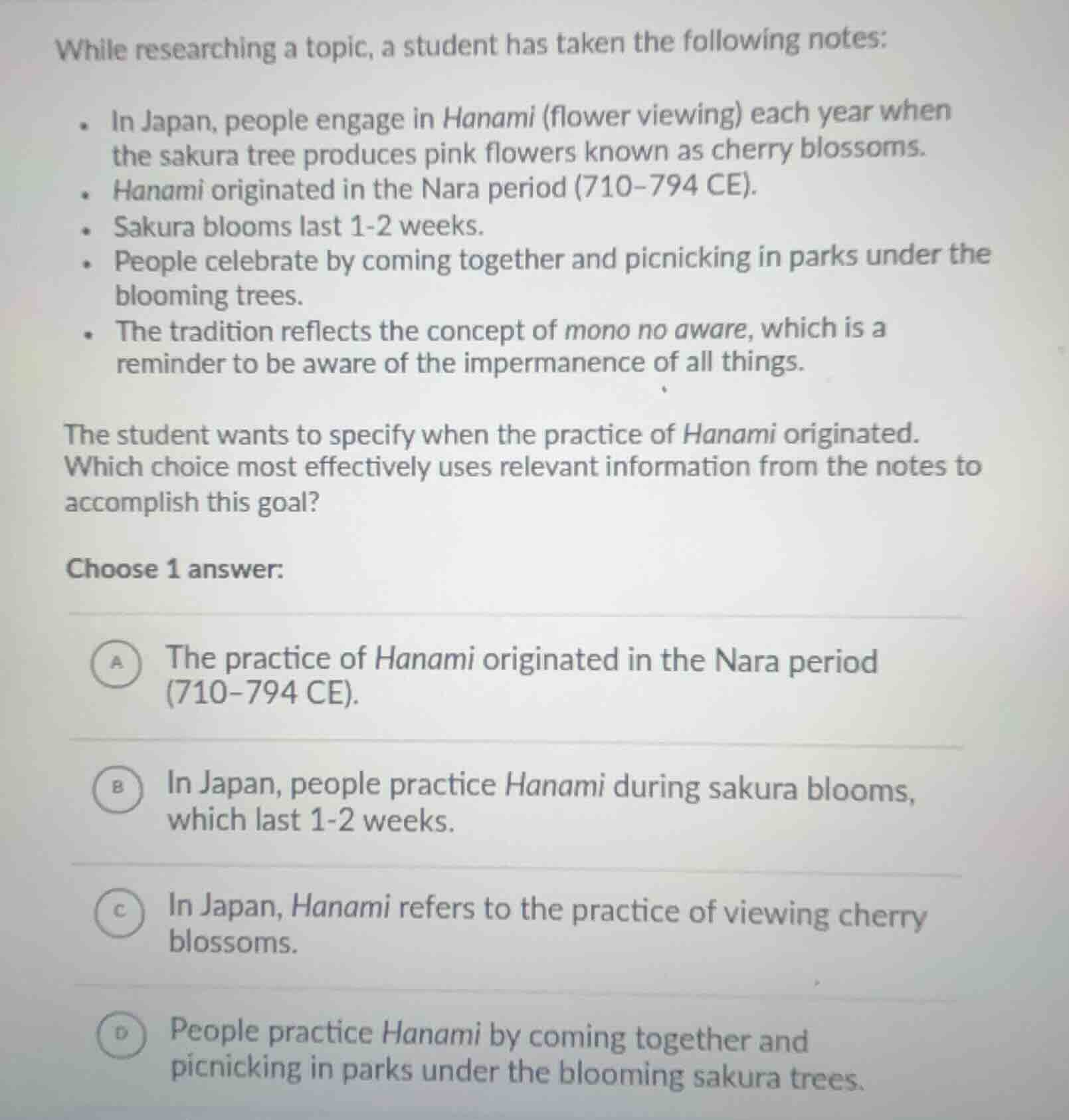
while researching a topic, a student has taken the following notes:
- in japan, people engage in hanami (flower viewing) each year when the sakura tree produces pink flowers known as cherry blossoms.
- hanami originated in the nara period (710–794 ce).
- sakura blooms last 1-2 weeks.
- people celebrate by coming together and picnicking in parks under the blooming trees.
- the tradition reflects the concept of mono no aware, which is a reminder to be aware of the impermanence of all things.
the student wants to specify when the practice of hanami originated. which choice most effectively uses relevant information from the notes to accomplish this goal?
choose 1 answer:
a the practice of hanami originated in the nara period (710–794 ce).
b in japan, people practice hanami during sakura blooms, which last 1-2 weeks.
c in japan, hanami refers to the practice of viewing cherry blossoms.
d people practice hanami by coming together and picnicking in parks under the blooming sakura trees.
To determine when Hanami originated, we analyze each option:
- Option A: Directly states Hanami originated in the Nara period (710 - 794 CE), which answers the question about its origin.
- Option B: Discusses the duration of sakura blooms during Hanami, not the origin.
- Option C: Defines Hanami, not its origin.
- Option D: Describes how people practice Hanami, not its origin.

Snap & solve any problem in the app
Get step-by-step solutions on Sovi AI
Photo-based solutions with guided steps
Explore more problems and detailed explanations
A. The practice of Hanami originated in the Nara period (710-794 CE).