QUESTION IMAGE
Question
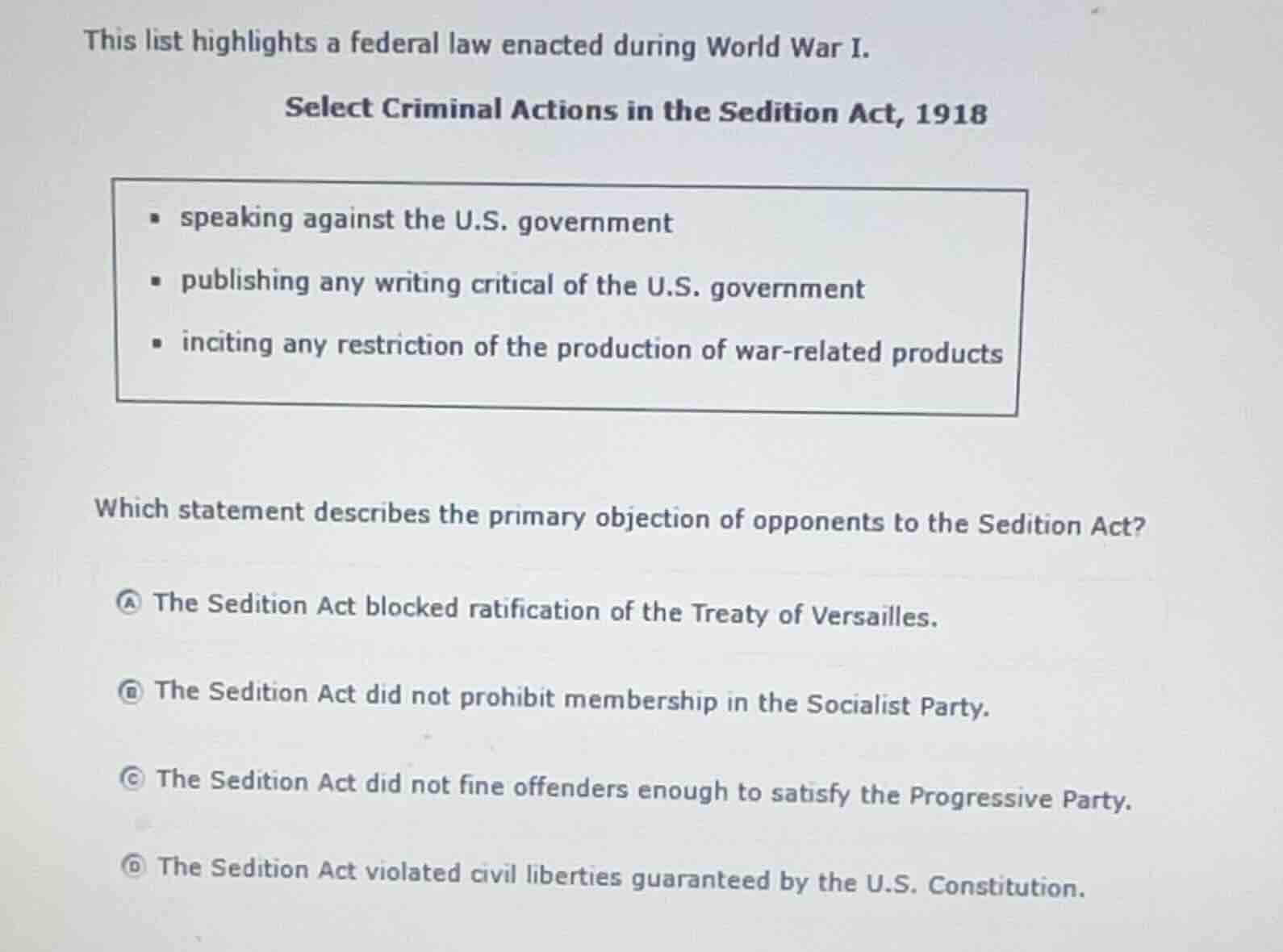
this list highlights a federal law enacted during world war i.
select criminal actions in the sedition act, 1918
- speaking against the u.s. government
- publishing any writing critical of the u.s. government
- inciting any restriction of the production of war - related products
which statement describes the primary objection of opponents to the sedition act?
a the sedition act blocked ratification of the treaty of versailles.
b the sedition act did not prohibit membership in the socialist party.
c the sedition act did not fine offenders enough to satisfy the progressive party.
d the sedition act violated civil liberties guaranteed by the u.s. constitution.
To determine the primary objection to the Sedition Act, we analyze each option:
- Option A: The Sedition Act (1918) is not related to the Treaty of Versailles' ratification (post - WWI), so this is incorrect.
- Option B: The main objection to the Sedition Act was not about Socialist Party membership, so this is wrong.
- Option C: The objection was not about the fines for offenders in relation to the Progressive Party, so this is incorrect.
- Option D: The Sedition Act restricted actions like speaking against the government and publishing critical writings. The First Amendment of the U.S. Constitution guarantees freedom of speech and press, so opponents argued the act violated these civil liberties.

Snap & solve any problem in the app
Get step-by-step solutions on Sovi AI
Photo-based solutions with guided steps
Explore more problems and detailed explanations
D. The Sedition Act violated civil liberties guaranteed by the U.S. Constitution.