QUESTION IMAGE
Question
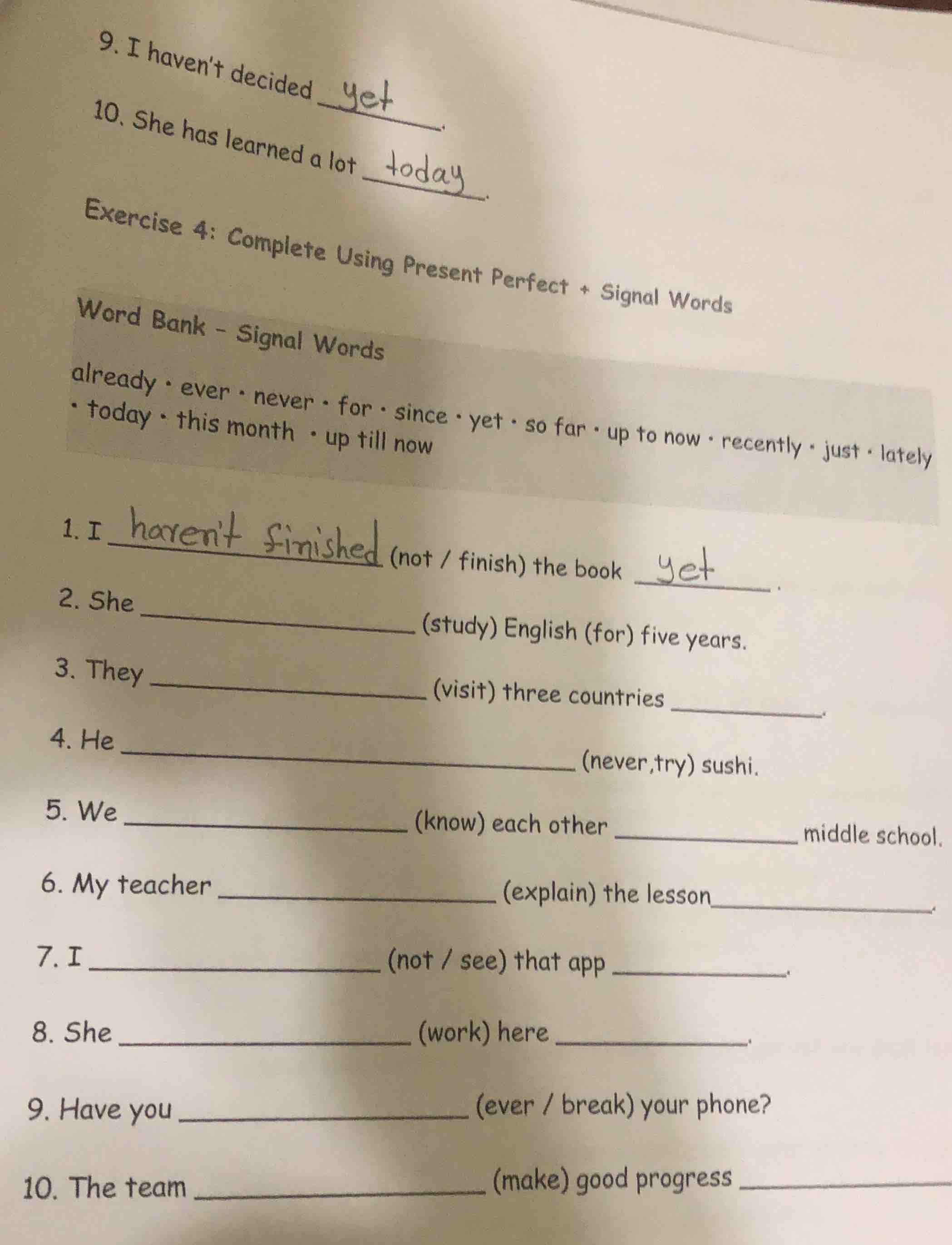
- i havent decided yet.
- she has learned a lot today.
exercise 4: complete using present perfect + signal words
word bank - signal words
already · ever · never · for · since · yet · so far · up to now · recently · just · lately · today · this month · up till now
- i havent finished (not / finish) the book yet.
- she (study) english (for) five years.
- they (visit) three countries.
- he (never,try) sushi.
- we (know) each other middle school.
- my teacher (explain) the lesson.
- i (not / see) that app.
- she (work) here.
- have you (ever / break) your phone?
- the team (make) good progress
Question 2
Step1: Determine the tense and subject-verb agreement
The sentence is in the present perfect tense. The subject "She" is third - person singular, so the structure of the present perfect tense is "has + past participle". The verb "study" has a past participle of "studied". And we use "for" to indicate a period of time (five years).
Step2: Form the sentence
So the sentence should be "She has studied English for five years."
Step1: Determine the tense and subject-verb agreement
The subject "They" is plural, and the present perfect tense structure for plural subjects is "have + past participle". The past participle of "visit" is "visited". We can choose a signal word from the word bank, for example, "so far" which is suitable for present perfect tense to indicate an action up to the present.
Step2: Form the sentence
So a possible sentence is "They have visited three countries so far." (Other signal words like "up to now", "lately" etc. can also be used as long as they fit the present perfect tense context.)
Step1: Determine the tense and subject-verb agreement
The subject "He" is third - person singular, and the present perfect tense structure is "has + past participle". The word "never" is used with the present perfect tense, and the past participle of "try" is "tried".
Step2: Form the sentence
So the sentence is "He has never tried sushi."

Snap & solve any problem in the app
Get step-by-step solutions on Sovi AI
Photo-based solutions with guided steps
Explore more problems and detailed explanations
has studied; for