QUESTION IMAGE
Question
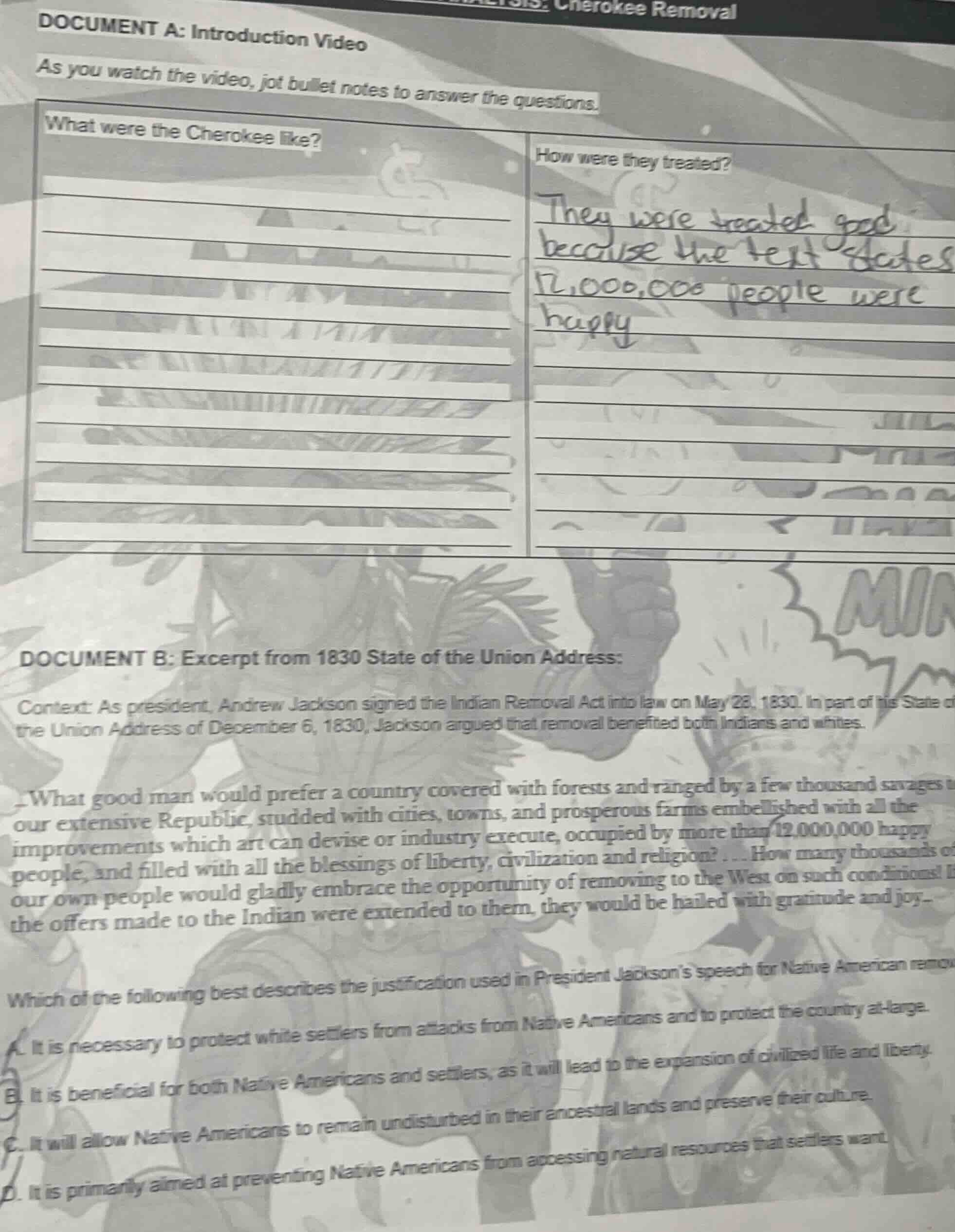
document a: introduction video
as you watch the video, jot bullet notes to answer the questions.
what were the cherokee like?
how were they treated?
document b: excerpt from 1830 state of the union address:
context: as president, andrew jackson signed the indian removal act into law on may 28, 1830. in part of his state of the union address of december 6, 1830, jackson argued that removal benefited both indians and whites.
what good man would prefer a country covered with forests and ranged by a few thousand savages to our extensive republic, studded with cities, towns, and prosperous farms embellished with all the improvements which art can devise or industry execute, occupied by more than 12,000,000 happy people, and filled with all the blessings of liberty, civilization and religion? ... how many thousands of our own people would gladly embrace the opportunity of removing to the west on such conditions! if the offers made to the indian were extended to them, they would be hailed with gratitude and joy.
which of the following best describes the justification used in president jackson’s speech for native american removal?
a. it is necessary to protect white settlers from attacks from native americans and to protect the country at - large.
b. it is beneficial for both native americans and settlers, as it will lead to the expansion of civilized life and liberty.
c. it will allow native americans to remain undisturbed in their ancestral lands and preserve their culture.
d. it is primarily aimed at preventing native americans from accessing natural resources that settlers want.
To solve this, we analyze the context and the options:
- The context states Jackson argued removal benefited both Indians and whites.
- Option A talks about protecting white settlers from attacks, but the context doesn't mention attacks as a justification.
- Option B says it's beneficial for both and leads to expansion of civilized life and liberty. This matches Jackson's argument (from the context: "Jackson argued that removal benefited both Indians and whites" and the excerpt's mention of "civilization and religion" etc.).
- Option C says it allows Native Americans to remain in ancestral lands, which is opposite of removal.
- Option D says it's to prevent Native Americans from accessing resources, which isn't supported by the context.

Snap & solve any problem in the app
Get step-by-step solutions on Sovi AI
Photo-based solutions with guided steps
Explore more problems and detailed explanations
B. It is beneficial for both Native Americans and settlers, as it will lead to the expansion of civilized life and liberty.